
European Portuguese vs. Brazilian Portuguese:
What's the Difference (and Why It Matters)?
You searched for Portuguese learning resources. You found Brazilian ones. Again.
If that sounds familiar, you're not alone, and you're not doing anything wrong.
Brazilian Portuguese dominates the internet. Most apps, most YouTube channels, most beginner courses are built around the Brazilian variety. So if you've ever typed "learn Portuguese" into a search bar and ended up somewhere that felt... slightly off... there's a simple reason for that.
You're learning European Portuguese. And that's a different thing.
Not better. Not worse. Different in ways that genuinely matter for your learning journey. This post will walk you through what those differences actually are, why they can cause so much confusion, and what it means for the way you approach learning.
The Same Language. Two Very Different Sounds.
Think of European Portuguese and Brazilian Portuguese the way you might think of British English and American English. Same language at the root. Shared grammar, shared vocabulary, largely mutually intelligible on the page. But when you hear them spoken? They can feel worlds apart.
Brazilian Portuguese tends to be open and melodic. Vowels are clear and fully pronounced. The rhythm has a warmth and flow to it that many learners find easier to follow at first, especially if you've been exposed to Brazilian music, telenovelas, or film.
European Portuguese - português europeu - is something else entirely. The vowels are compressed, often swallowed. Unstressed syllables drop away almost completely. The rhythm is dense and percussive in a way that surprises most learners the first time they hear it. Words that look simple on paper can sound almost unrecognizable when a native speaker from Lisboa says them at natural speed.
This is not your ear failing you. It's simply a different sound world; one that takes time and exposure to tune into.
Why Does European Portuguese Sound So Different? A Closer Look at Pronunciation
The single biggest reason European Portuguese sounds so different from Brazilian Portuguese, and from what most learners expect, comes down to one thing: what happens to vowels when they're not stressed.
Vowel Reduction: The Heart of the Matter
In European Portuguese, unstressed vowels don't just get quieter. They compress, blur, and often disappear almost entirely. This is especially true of the letters e and o when they appear in unstressed syllables.

Or consider bom dia (good morning). In Brazil: bom JEE-ah, warm and open. In Portugal: something closer to bomd'ya with the second syllable folded almost into the first. Same words. Very different sound.
This is why so many learners say, "I can read European Portuguese fine, but I can't understand anything when people actually speak." You're not missing something. You're simply hearing a variety where the written word and the spoken word have drifted further apart than you might expect.
The good news is that your ear adjusts. It just needs time and real exposure, not more grammar study.

The lh and nh Sounds
European Portuguese has two consonant combinations that often surprise learners: lh and nh.
The lh sound, as in filho (son) or trabalho (work), is a palatal lateral. The closest English approximation is the lli in "million," but softer and more fluid. In Brazilian Portuguese, this sound is often pronounced similarly, though regional accents vary. In European Portuguese, it tends to be crisper and more consistently produced.
The nh sound, as in vinho (wine) or the suffix anha, is the nasal equivalent. It’s similar to the ny in "canyon." Again, present in both varieties, but the European pronunciation tends to be slightly more forward in the mouth.
These sounds feel unfamiliar at first, but they're among the most satisfying to get right. And once you hear them in context, for example hearing the word vinho said properly by someone ordering wine at a tasca in Porto, they stop being abstract phonetics and start being part of the language's texture.
Nasal Vowels: Portugal's Distinctive Quality
One of the most distinctive features of European Portuguese, and one that learners often find both beautiful and baffling, is its nasal vowels. These are vowels produced with air flowing through both the mouth and the nose simultaneously, creating a resonant, humming quality.
You find them in words like pão (bread), mão (hand), irmã (sister), and também (also, too). The tilde (~) is your visual cue, though nasal vowels also appear before m and n in certain positions.
Brazilian Portuguese has nasal vowels too, but they tend to be pronounced more openly and with more movement in the mouth. The European versions are tighter, more contained. Some learners describe the EP nasal vowel as feeling like the sound almost stays inside; which, in a way, it does.
There's no shortcut to these sounds. The best way to absorb them is simply to listen, a lot, to real European Portuguese being spoken. Podcasts, films, conversations. Let your ear do the work before your brain tries to analyse it.
The s at the End of Words (and Syllables)
In European Portuguese, an s at the end of a word or before a consonant is typically pronounced as sh (like the English "sh" in "shoe"). In Brazilian Portuguese, it stays as a plain s sound.

This is one of the most immediately recognizable features of a European Portuguese accent. And once you tune your ear to it, you'll hear it everywhere.

Vocabulary: The Words That Set You Apart
Beyond pronunciation, European and Brazilian Portuguese have developed distinct vocabularies in some everyday areas. Not across the board as the vast majority of the language is shared, but in common situations the differences are worth knowing.
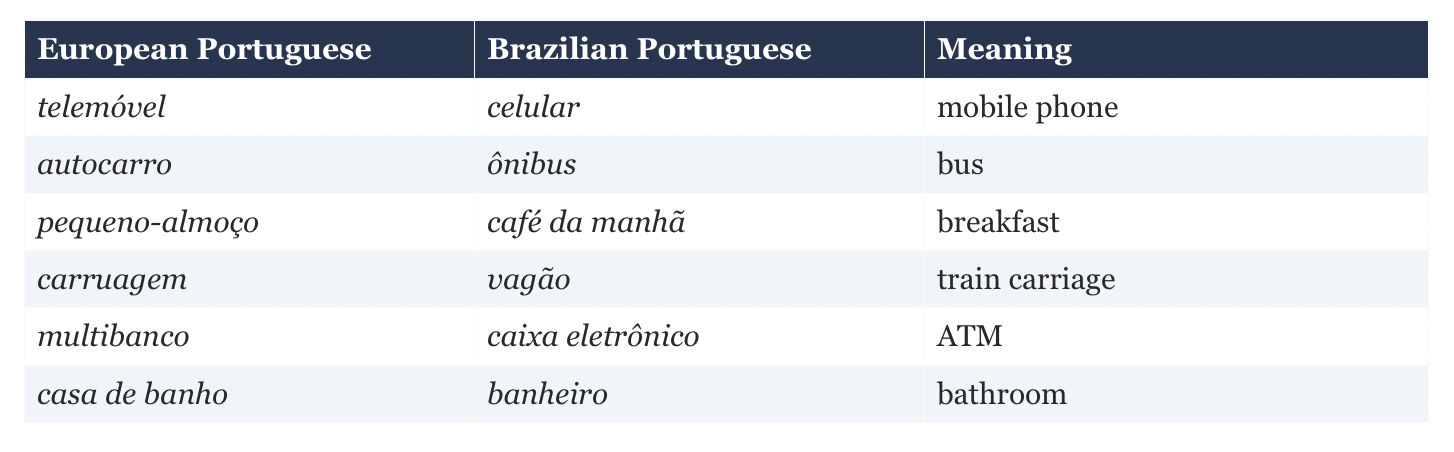
These aren't trick questions or gotchas. They're simply part of knowing which Portuguese you're learning, and learning European Portuguese means learning the words that Portuguese people actually use.
Grammar: Where the Differences Go Deeper
This is the area that surprises people most, because on the surface, the grammar of European and Brazilian Portuguese looks almost identical. And in many ways, it is. But there are a handful of differences that show up constantly in real conversation, and they're worth understanding from the start.
How You Say "You" And Why It's More Complicated Than You Think
In Brazilian Portuguese, você is the standard, everyday word for "you" in most contexts. It's warm, natural, and used freely in conversation at every level of formality.
In European Portuguese, você exists but it carries a different weight. Used in the wrong context in Portugal, it can sound oddly formal, even a little cold or distant. Among friends, family, or in casual situations, European Portuguese speakers often drop the pronoun entirely, or use the person's name, or a term of address.
Instead of "Do you want a coffee?" (Você quer um café?), a Portuguese person might simply say Quer um café? ("Want a coffee?") with no pronoun at all. The verb form tells you who's being addressed.
There's also tu, the informal "you" used with friends, family, and people of a similar age or status. Tu is far more common in everyday European Portuguese than in Brazilian Portuguese, where você has largely taken over that role.

Object Pronouns: Before or After the Verb?
In Brazilian Portuguese, object pronouns tend to come before the verb in everyday speech. Te amo (I love you) and Me dá isso (Give me that) feel natural to Brazilian ears and are the norm in informal conversation.
In European Portuguese, the traditional placement is after the verb, attached with a hyphen: amo-te, dá-mo. This is called mesoclisis and enclisis, though you don't need those words. What you need is to know that if you write Me liga (Call me) the way a Brazilian speaker would, it will feel immediately out of place to a European Portuguese reader or listener.

In practice, spoken European Portuguese is more flexible than the written rules suggest. But the written standard, and the instinct of native speakers, remains attached to the post-verbal placement. It's one of those areas where learning from European Portuguese sources from the beginning makes your life considerably simpler.
The Gerund vs. the Infinitive
This one is small but distinctive. Brazilian Portuguese uses the gerund (the -ndo form, like estou comendo, "I am eating") constantly. It's the natural, conversational way to express ongoing action in Brazil.
European Portuguese almost never uses the gerund this way in everyday speech. Instead, it uses a preposition plus the infinitive: estou a comer - literally "I am at eating." The construction feels unusual at first, but it becomes completely natural with exposure.
{Where the gerund does appear in European Portuguese is in adverbial phrases describing how or while something happens - saiu correndo would be odd, but entrou cantando (he came in singing) or fui andando (I just kept walking) are natural uses you'll still encounter. It's describing a manner or simultaneous action, not a progressive tense.}

You'll hear estou a trabalhar (I'm working), estamos a aprender (we're learning), ele está a falar (he's speaking) constantly in Portugal. If you arrive in Lisbon saying estou trabalhando, you'll be understood, but you'll also be gently flagged, again, as someone who learned the other variety.
So Why Does It Matter Which One You Learn?
Here's the honest answer: it depends entirely on why you're learning.
If your goal is to visit or live in Portugal, connect with Portuguese family, work in a Portuguese-speaking context in Europe, or simply feel at home in the specific culture and sound of Portugal, then learning European Portuguese from the beginning is not just a preference. It's the right foundation.
It's not that you can't be understood in Portugal if you've learned Brazilian Portuguese. You can. Portuguese speakers across the world understand one another. But there's a difference between being understood and feeling at home. Between speaking correctly and speaking naturally. Between saying the right words and sounding like someone who truly knows the language and the place.
At Conversa Club, we teach European Portuguese. Not because Brazilian Portuguese is wrong, but because European Portuguese is what we know deeply, what Sérgio has spent a lifetime studying and living, and what our community is here to explore together.
If You've Been Learning Brazilian Portuguese - What Now?
First: nothing you've learned is wasted. Genuinely. The grammar foundations, the vocabulary, the confidence you've built. all of it carries over.
What will need some attention is your ear and a few specific habits. The vowel reduction, the sh sound, the estou a fazer construction instead of estou fazendo. These aren't mountains. They're adjustments. And the best way to make them is through real exposure to European Portuguese being spoken, at natural speed, in real contexts.
That's exactly what the Conversa Club community is built for.
Uma Última Palavra (One Last Word)
Learning any variety of Portuguese is a worthwhile, beautiful thing. But if Portugal is your destination (geographically, culturally, or emotionally) then European Portuguese is your language.
It has its own sound, its own rhythm, its own alma (soul). And yes, it takes a little patience to tune your ear into. But when it clicks - when you're sitting in a pastelaria in Lisboa and you realize you understand the conversation at the next table - that feeling is unlike anything else.
You're in the right place. Take your time. Uma pequena etapa de cada vez - one small step at a time.
Sérgio is the founder of Conversa Club, an online community for adult learners of European Portuguese. Born in the US to Portuguese immigrant parents and educated in both countries, he has spent two decades helping learners find their footing in European Portuguese. If this resonated with you, we'd love to have you in the community. Come and explore what's waiting for you, em português.
→ Ready to take your next step? Join the Conversa Club community and start practicing European Portuguese with people who are on the same journey.
