
The Day Portugal Chose Freedom - And What It Still Means Today
Every April 25th, Portugal pauses. Streets fill with carnations, music, and memory. Here’s why this day matters, and how understanding it will change the way you hear the language.
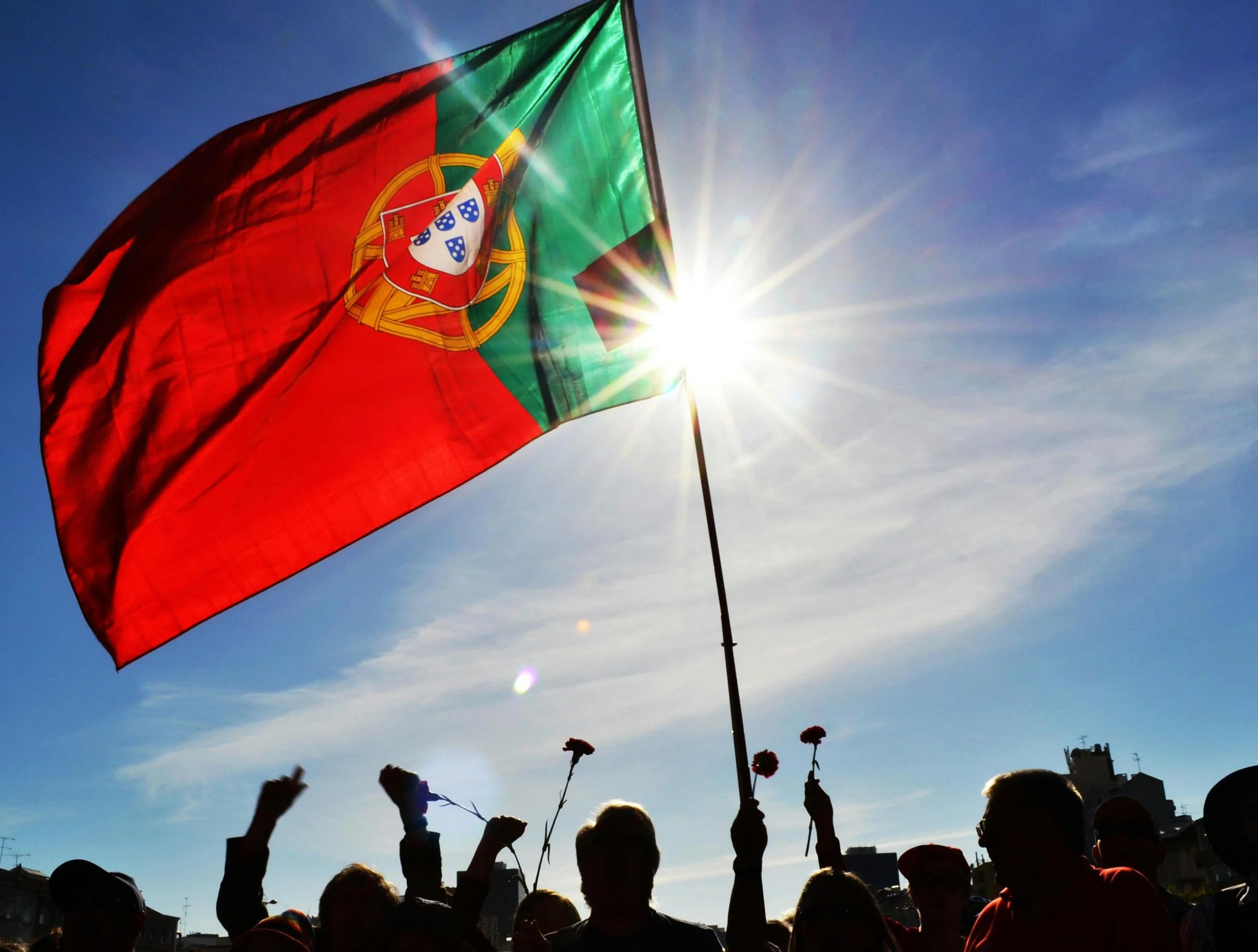
On o Dia da Liberdade, Freedom Day, streets fill with red carnations. Music drifts from open windows and public stages. Old songs — songs that were once dangerous to sing — are performed openly and joyfully. And if you are learning European Portuguese, understanding what happened on April 25th, 1974 will change the way you hear the language forever.
A Revolution Unlike Any Other
Most revolutions in history are defined by what was destroyed. The Revolução dos Cravos, the Carnation Revolution, is remembered for what was preserved.
On the morning of April 25th, 1974, a military movement known as the Movimento das Forças Armadas, or MFA, launched a carefully coordinated uprising against Portugal's authoritarian Estado Novo regime. This regime had ruled Portugal for nearly five decades, first under António de Oliveira Salazar and then under Marcelo Caetano, maintaining power through censorship, surveillance, and the feared secret police, the PIDE.
For 48 years, the word liberdade, freedom, carried a kind of underground electricity. You could not speak freely. You could not read freely. You could not leave the country freely. Dissidents disappeared. Journalists self-censored. An entire generation grew up knowing that certain words, certain ideas, certain conversations were not safe to have in public.
And then, on a spring morning in Lisbon, it ended.
The signal for the uprising was a song. At 12:20 am on April 25th, a radio station broadcast Grândola, Vila Morena, a folk song by Zeca Afonso that had been banned by the regime for its themes of brotherhood and solidarity. When soldiers and citizens heard it on the radio, they knew: it was time.
By morning, tanks were moving through Lisbon. But something unexpected was happening alongside the military action. City inhabitants defied the ban to stay home and gradually mixed with the military. Civilians came out of their homes not in fear, but in support.
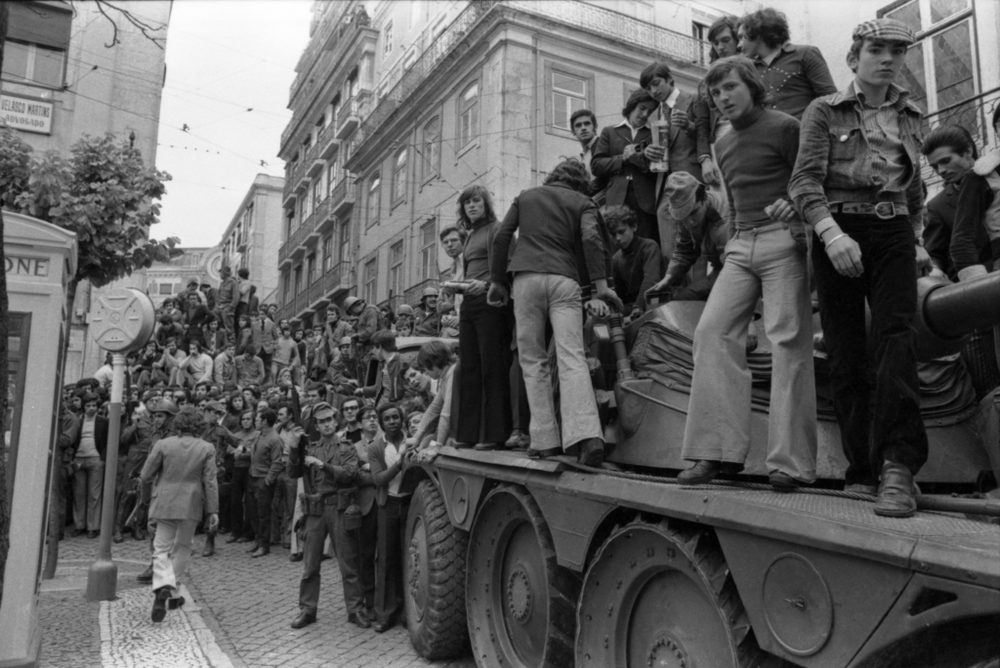
The public supports the Movimento das Forças Armadas (MFA) in the streets of Lisbon on April 25th, 1974.
By the end of the day, the regime had fallen. Caetano surrendered. Political prisoners were released. The secret police headquarters were surrounded. And Portugal, after nearly half a century of silence, began to exhale.
There were no mass casualties. No prolonged civil war. What happened was, in its own quiet way, deeply and recognizably Portuguese - restrained emotion, beauty in the details, and a resilience that had been building, slowly and steadily, for decades.
O Estado Novo: Understanding what came before
To truly understand the significance of o Dia da Liberdade, it helps to understand what Portugal was living under before April 25th, 1974.
O Estado Novo, which translates literally as the New State, was established in 1933 under Salazar, an economics professor who rose to become one of Europe's longest-serving dictators. His regime was conservative, nationalist, and deeply repressive. It drew on the structures of the Catholic Church, maintained an empire in Africa long past the era of decolonization, and used the PIDE, Polícia Internacional e de Defesa do Estado, to monitor, arrest, and silence its opponents.
Portugal under Estado Novo was a country that stood still while the rest of Europe changed. While neighboring Spain and other Western nations modernized through the post-war decades, Portugal remained agricultural, largely rural, and deliberately isolated. Emigration was controlled. Education was limited. The press was censored. And the colonial wars in Angola, Mozambique, and Guinea-Bissau drained the country of a generation of young men and resources.
By the early 1970s, exhaustion had set in — within the military, within civil society, and within Portugal itself. Inflation was high and Portugal had been hit hard by the 1973 oil crisis.
The revolution that came on April 25th, 1974 was not a sudden explosion. It was the result of years of quiet resistance, careful organizing, and a collective decision that enough was enough.
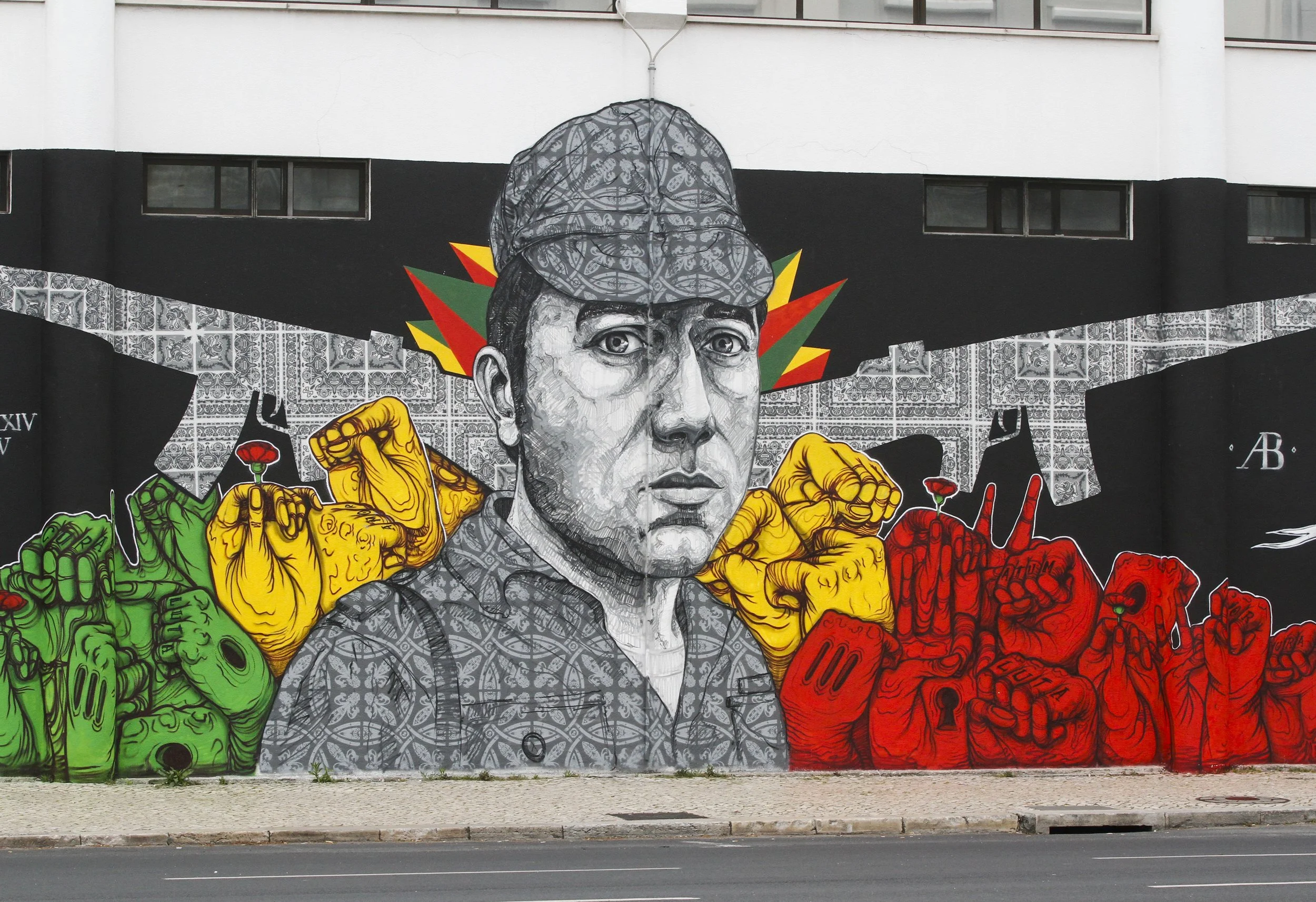
Mural 25 de Abril de Frederico Draw, Gonçalo Ribeiro, Add Fuel e Miguel Januário, Av. Berna, 2014
O Cravo Vermelho: Why the carnation?
The red carnation, o cravo vermelho, became the symbol of the revolution almost by accident, which makes it feel all the more genuine.
In the hours after the uprising began, florists near Lisbon's markets had just received their morning deliveries of carnations — it was the season, and they were in abundance. As soldiers took up positions in the streets, civilians approached them not in fear but in solidarity. Someone offered flowers. The soldiers accepted.
The image of a rifle barrel holding a carnation rather than being pointed at a person became one of the defining images of the 20th century in Portugal. It captured something that words struggled to say: that this was a revolution built on the belief that freedom and humanity were not in opposition; that you could lay down the tools of violence and still change everything.
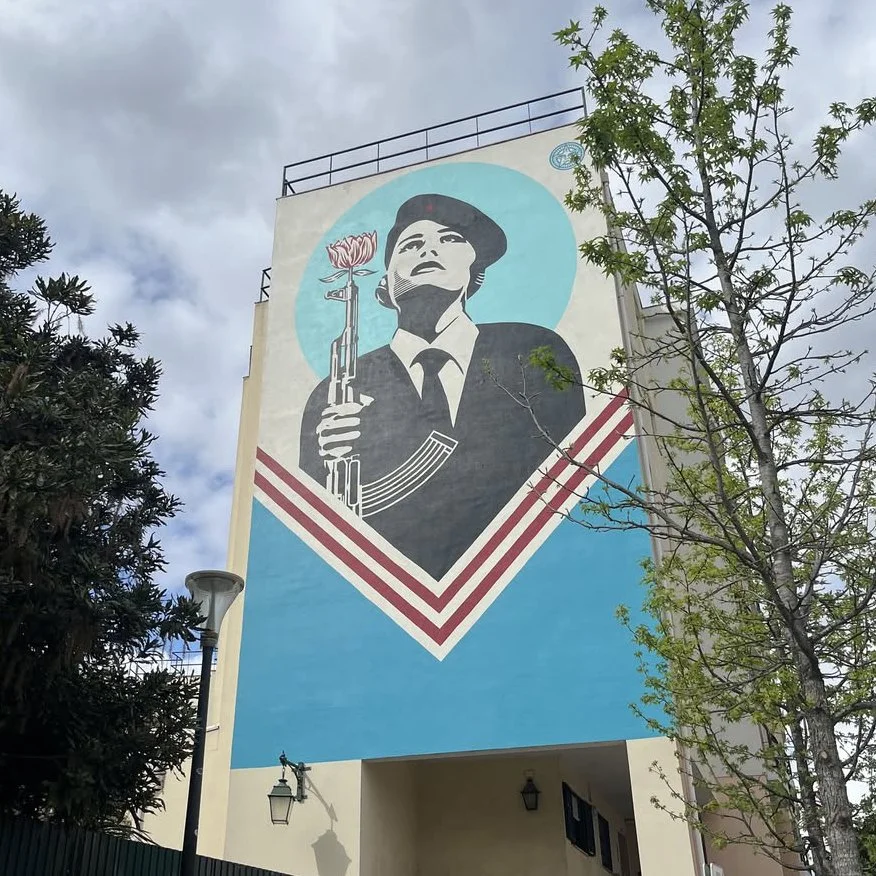
Peace Guard by Shepard Fairey (Obey) and Alexandre Farto (Vhils), honoring the 1974 Carnation Revolution, located in the Graça neighborhood at Rua da Senhora da Glória 39
Today, o cravo vermelho remains one of the most emotionally charged symbols in Portuguese culture. You will see it in art, in ceramics, in murals on old walls in Lisbon's Mouraria and Intendente neighborhoods. If you learn to recognize it, you will start to see it everywhere; and you will understand exactly what it means.
What April 25th looks like today
O Dia da Liberdade is a national public holiday, which means that across Portugal, daily life pauses. But unlike some holidays that feel purely ceremonial, this one is genuinely felt, particularly in Lisbon and Porto, where the largest public commemorations take place.
In Lisbon, the heart of the celebrations is a Avenida da Liberdade, the Avenue of Freedom. The name itself is significant: this wide, tree-lined boulevard in the center of the city takes on its full meaning on April 25th. Throughout the day, there are parades, public concerts, political gatherings, and cultural events that draw thousands of people from across the city and the country.
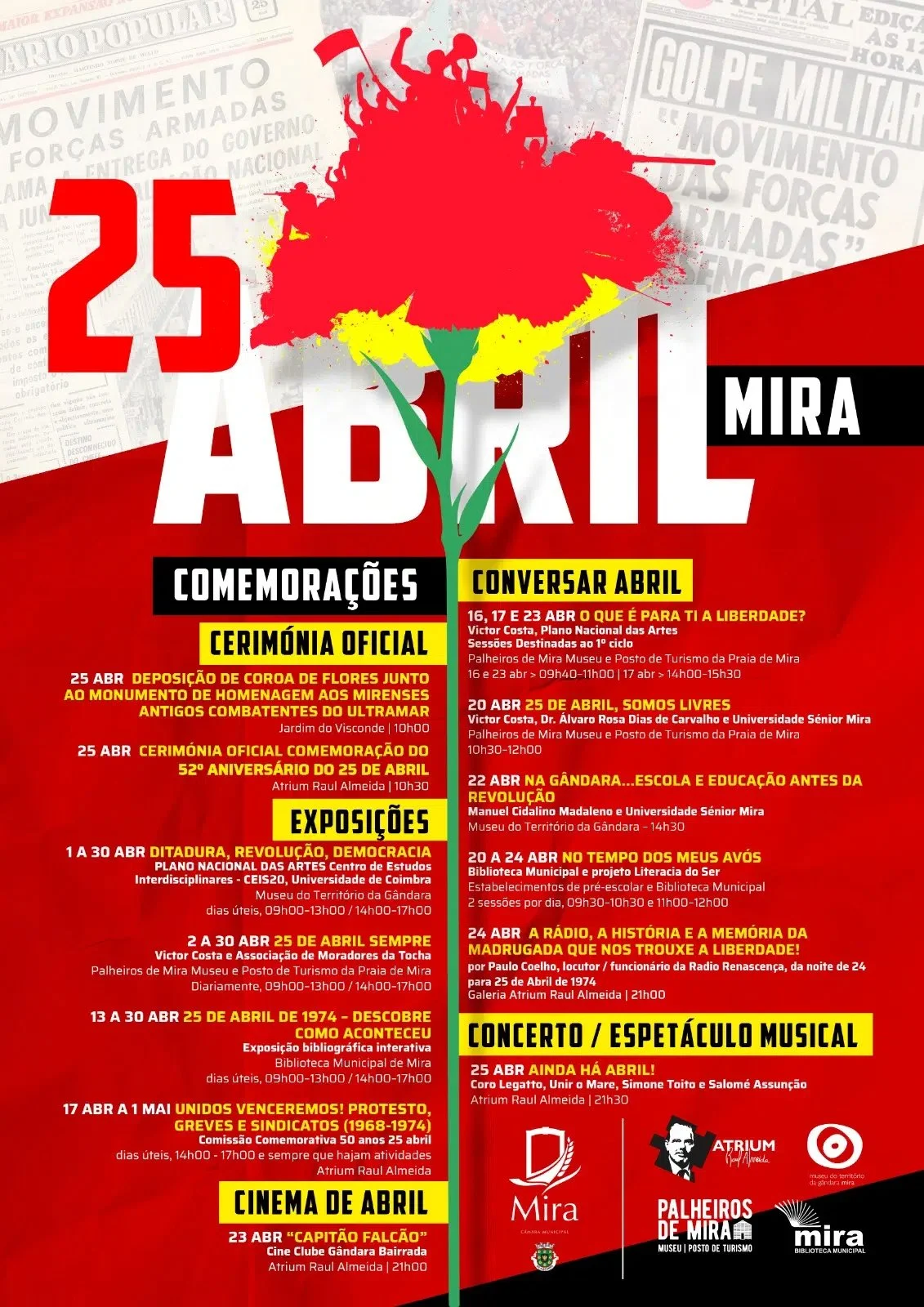
Program from the city of Mira in Portugal outlining the various activities in 2026 celebrating Dia da Liberdade, 25 de Abril, April 25th, The Carnation Revolution
You will hear music everywhere. In particular, you will hear as canções de Abril, the songs of April. These are the folk songs and protest songs that carried the spirit of resistance through the years of dictatorship - songs by Zeca Afonso, Sérgio Godinho, and others whose work was banned or censored under Estado Novo. Grândola, Vila Morena remains the anthem of the day. When it plays, people stop, listen, and often sing along. Even those who were not alive in 1974 know the words.
In Porto, a Avenida dos Aliados fills with people, concerts, and red carnations. Porto has its own relationship with the history of the revolution; the northern city was a stronghold of resistance in various forms, and the celebrations there feel equally deep and genuinely held.
Across smaller cities, towns, and villages, April 25th is marked in quieter ways: local ceremonies, school events, conversations between generations. In family homes, grandparents who remember what life was like before 1974 sometimes tell their stories on this day, and those stories are listened to carefully.
Language and freedom: What this means for your Portuguese
Here is something worth sitting with: when you learn a language, you are not just learning vocabulary and grammar. You are learning the emotional landscape of an entire culture. And in European Portuguese, few things have shaped that landscape more profoundly than April 25th, 1974.
The word liberdade (freedom) is not a neutral word in Portuguese. It carries weight. When a Portuguese person says it, they are drawing, consciously or not, on nearly five decades of its absence. The same is true of words like resistência (resistance) and silêncio (silence). These are not abstract concepts in the way they might be in other cultural contexts. They are lived.
Even saudade, that famously untranslatable Portuguese feeling of longing for something absent, takes on a particular texture when you understand that for a generation of Portuguese people, what they longed for most deeply was the freedom to speak, to travel, to gather, to disagree openly. Saudade is not only about love lost or landscapes left behind. It is also, sometimes, about a version of life that felt just out of reach for a very long time.
Understanding this gives you access to something that no grammar textbook can offer: emotional fluency. The ability to recognize not just what a word means, but what it feels like to say it, and why.
Words and phrases worth knowing
If you find yourself in Portugal around April 25th - or simply want to understand conversations, news coverage, and cultural references - here are a few words and phrases worth knowing.
O Dia da Liberdade - Freedom Day - The official name for April 25th as a national holiday.
A Revolução dos Cravos - the Carnation Revolution - The name given to the events of April 25th, 1974.
O cravo vermelho - the red carnation - The symbol of the revolution.
Liberdade - freedom
As canções de Abril - the songs of April - The folk and protest songs associated with the revolution and its spirit.
O Estado Novo - the New State - The authoritarian regime that governed Portugal from 1933 to 1974.
Viva o 25 de Abril - Long live the 25th of April
Abril de Abril - a poetic, slightly layered way of referring to April as the month of the revolution. You will sometimes hear this in song, poetry, and reflective speech.
Grândola, Vila Morena: Why a song became a signal
It is worth saying a little more about the song that started everything, because it tells you something important about how deeply Portuguese culture weaves together music, identity, and resistance.
Grândola, Vila Morena was written and recorded by José Afonso, known as Zeca Afonso, a singer and songwriter who became one of the most beloved figures in Portuguese music. The song is, on the surface, a simple tribute to the town of Grândola in the Alentejo region and the spirit of brotherhood he found among its people. But its themes of solidarity and equality made it a target for Estado Novo censors, and it was banned from Portuguese radio.
Using it as the signal for the revolution was, in retrospect, a perfect choice. It was a song about the people, broadcast to the people, calling them quietly and in the middle of the night to their own liberation.
Today, Grândola, Vila Morena is played every year at midnight on April 24th, marking the beginning of the anniversary.
A living memory
What strikes visitors to Portugal on April 25th, and what strikes learners of Portuguese who begin to understand this history, is how alive the memory still is.
This is not a dusty commemoration for the history books. It is genuinely felt, year after year, because many people who lived through the Estado Novo are still alive. Because their children grew up hearing the stories. Because the songs still play, and the flowers still come out, and the word liberdade still carries that particular electrical charge that it earned over half a century of absence.
If you are planning to be in Portugal around April 25th, go to Lisbon. Walk a Avenida da Liberdade. Listen to the music. Watch what happens on people's faces when Grândola, Vila Morena begins to play.
And if you are not in Portugal, know that understanding this day is one of the most meaningful steps you can take toward understanding not just the language, but the people who speak it.
Real fluency is not about accent or grammar. It is about connection. It is about knowing what a red carnation means.
Here are some resources to explore if you’re looking for more information about Dia de Liberdade:
To understand the history
The film Capitães de Abril (2000), directed by Maria de Medeiros, is a dramatized but well-researched account of the revolution from the perspective of the military captains who led it. It is available with subtitles and gives a genuinely felt sense of the day.
For reading, Kenneth Maxwell's The Making of Portuguese Democracy is considered one of the most thorough English-language accounts of the Carnation Revolution and its aftermath.
To hear the music
Zeca Afonso's album Cantigas do Maio is the essential starting point; it contains Grândola, Vila Morena and gives full context for the folk-protest tradition he was working in. Spotify and YouTube both have his catalogue. (Available on FNAC, YouTube, Spotify, etc.)
For European Portuguese learners specifically
The RTP Play platform (rtp.pt) is Portugal's public broadcaster and streams news, documentaries, and cultural programming entirely in European Portuguese. Around April 25th, they typically air archival footage and special programming about the revolution. This provides authentic, real-Portugal listening practice with genuine emotional weight.
The Museu do Aljube in Lisbon is dedicated entirely to the resistance against the Estado Novo and the memory of the revolution. Their website (museudoaljube.pt) has some English content and is worth exploring before or after a visit.
For a broader cultural grounding
José Saramago's novels, particularly Raised from the Ground, are set in the Alentejo during exactly this period of Portuguese history. Reading Saramago alongside learning European Portuguese is a long game, but even in translation he gives you access to the texture of what life felt like in Portugal before and after 1974.
One honest note: much of the richest material about this period exists in Portuguese, which makes it both a challenge and an opportunity. As your European Portuguese grows, revisiting these events through Portuguese-language sources becomes one of the most rewarding things you can do — history and language practice woven into the same experience.
