
What is the CIPLE exam?
A Guide to Portugal’s A2 Language Test
If you’ve spent any time researching Portuguese citizenship, residency, or visa requirements, you’ve probably come across the CIPLE exam.
It can sound bureaucratic at first; another form, another requirement, another hoop. But the CIPLE exam is actually a fairly approachable, well-defined test, and understanding what it involves tends to make the whole process feel a lot less intimidating.
Here is what the CIPLE exam is, who typically needs it, and how to prepare for it without stress.
What is the CIPLE exam?
CIPLE stands for Certificado Inicial de Português Língua Estrangeira, the Initial Certificate of Portuguese as a Foreign Language. It’s administered by CAPLE (Centro de Avaliação de Português Língua Estrangeira), the official Portuguese language assessment center based at the University of Lisbon.
The CIPLE corresponds to the A2 level on the Common European Framework of Reference for Languages (CEFR), the same scale used across Europe to describe language ability, from A1 (beginner) through C2 (mastery).
At the A2 level, the exam is designed to confirm that you can handle a limited but real set of everyday situations in European Portuguese: understanding a notice posted in the street, reading a simple menu, following basic directions, or having a short conversation about yourself and familiar topics. It does not test literature, advanced grammar, or abstract vocabulary. It tests whether you can function, calmly and clearly, in ordinary Portuguese life.
Why this matters for nationality applications
Under current Portuguese law, the CIPLE (A2 level) is recognized as the minimum language requirement for acquiring Portuguese nationality. If you’re pursuing citizenship, this is very likely the exam you will need.
Who should take the CIPLE exam?
The CIPLE tends to come up for a few different kinds of learners, and you may recognize yourself in more than one of these.
People applying for Portuguese citizenship or nationality
This is the most common reason learners seek out this exam specifically. If proving A2-level Portuguese is part of your nationality file, the CIPLE is the recognized way to demonstrate it.
People applying for certain visas or residency pathways
Some residency processes also look for a baseline level of Portuguese, and the CIPLE is a clear, internationally recognized way to show that you meet it.
Learners who simply want a benchmark
Not everyone takes the CIPLE out of necessity. Some learners, especially those who’ve been practicing for a while without any formal milestone, like having an official, external measure of where they stand. There’s no obligation to start at A2 either; CAPLE allows candidates to register directly for a higher-level exam if that feels more appropriate.
One detail worth knowing early: candidates must generally be 16 years of age or older to sit the standard CIPLE. Younger learners are not excluded; there’s a school-adapted version, CIPLE-e, for ages 12 to 15, and a separate exam called TEJO for ages 9 to 11. If you’re guiding a younger learner toward European Portuguese, it’s worth knowing these exist, even though they fall outside what most Conversa Club members will need.
Where CIPLE fits among CAPLE's other exams
It helps to see the CIPLE in context. CAPLE offers a full range of exams across the CEFR scale, and each one serves a different purpose:
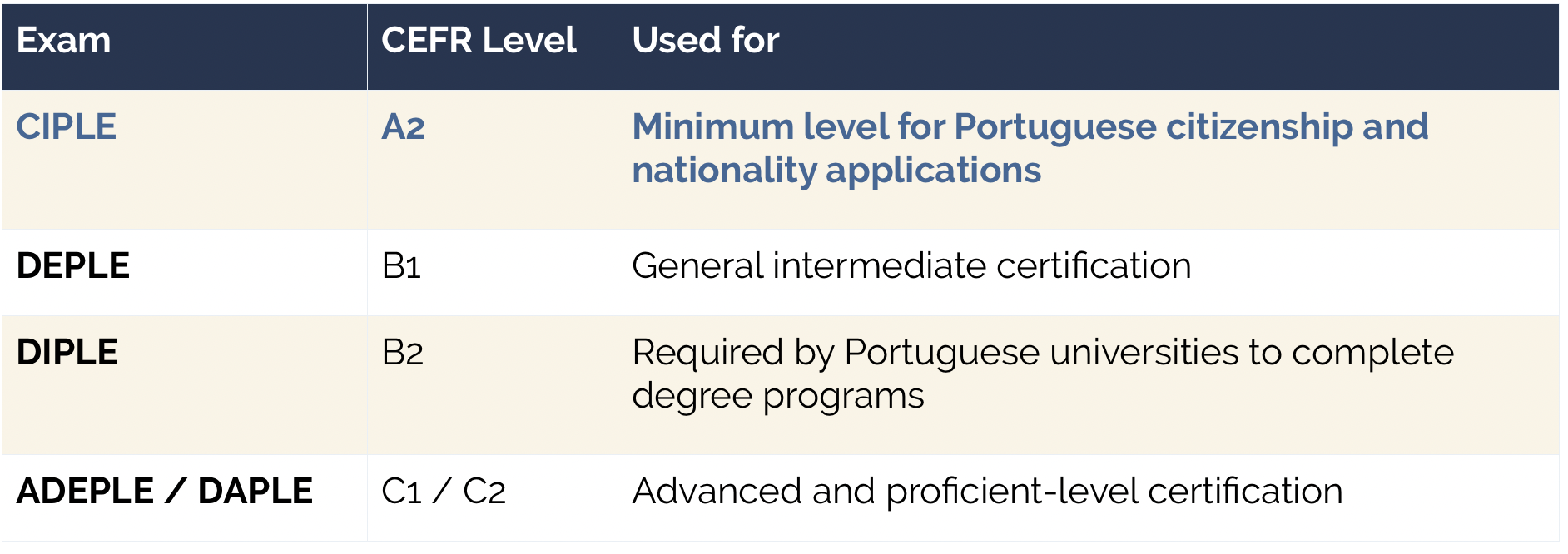
If your goal is citizenship, CIPLE is almost certainly the exam you need, and there’s no requirement to work your way up from A1 first. If you’re aiming for a Portuguese university degree, you’ll eventually need DIPLE (B2), and the CIPLE can be a calm, confidence-building first step toward that.
What does the CIPLE exam actually look like?
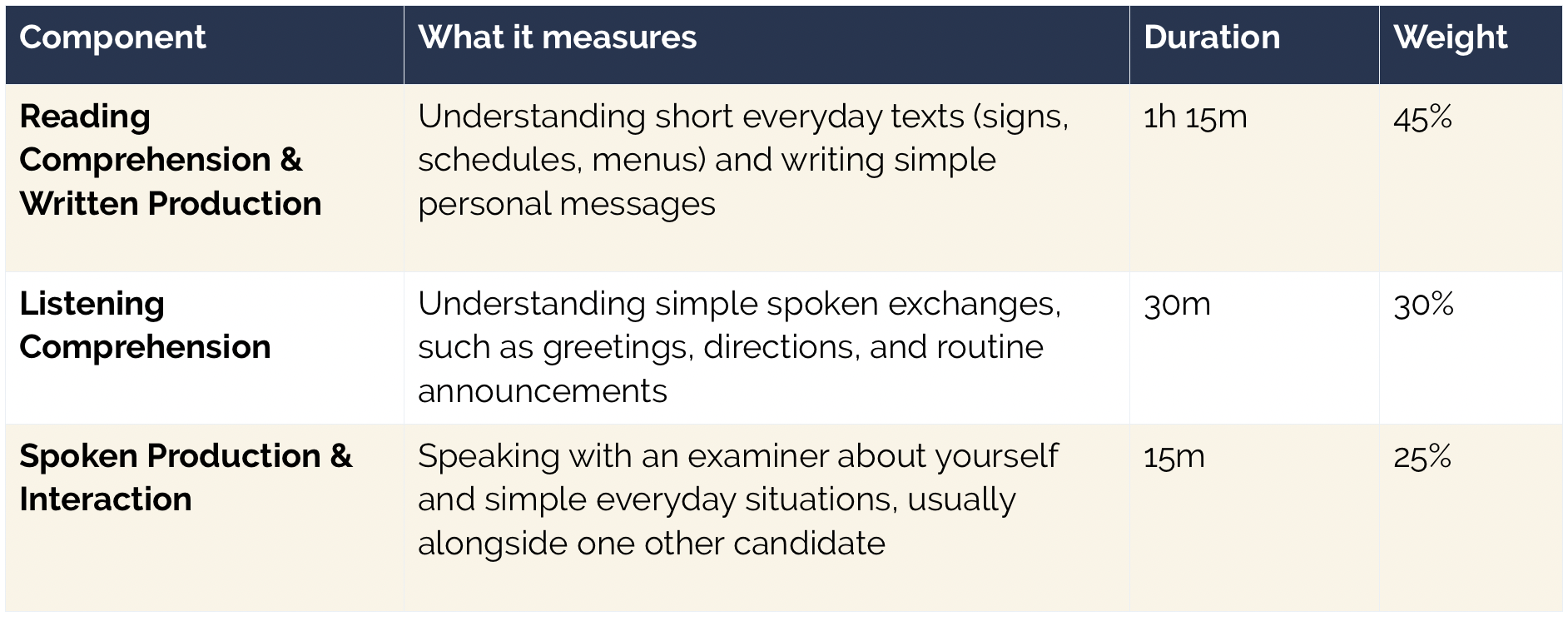
The CIPLE is built around three skills, assessed across four components. Altogether, the exam takes about two hours, plus a short break.
Reading and written production
This section asks you to read short, practical texts such as public notices, schedules, and simple newspaper items. It also requires you to answer multiple-choice or matching questions. The written half asks you to produce two short texts, such as a postcard or a simple personal message, on everyday topics.
Listening comprehension
You’ll hear short recordings in an informal register, the kind of exchanges you would encounter at a bank, a pharmacy, or on the phone, and answer multiple-choice questions based on what you understood.
Spoken production and interaction
This part usually takes place with two candidates at once, speaking with an examiner. It has three stages: a short personal introduction, a simple role-play of an everyday situation (asking for a hotel room, ordering at a café, that kind of thing), and a brief conversation about a current topic.
Final scores are reported as Muito Bom (85–100%), Bom (70–84%), or Suficiente (55–69%), and a passing result earns you an official certificate.
How to prepare for the CIPLE exam
CAPLE does not require or run any official preparation course. You’re free to prepare in the way that actually works for you. That said, a little structure goes a long way. Here is where we would suggest starting.
1. Get familiar with the format before anything else.
CAPLE publishes official sample materials for every exam, including the CIPLE. Looking through a real sample, even once, does more for your confidence than weeks of general study, because it removes the mystery of what you’ll actually be asked to do.
2. Practice listening to natural, everyday European Portuguese.
The listening section reflects real, informal speech; not slow, textbook Portuguese. Spend time with podcasts, the radio, or conversation partners who speak at a normal pace. This is exactly the kind of practice a community built around real conversation can offer.
3. Practice writing short, everyday texts.
Try writing a short postcard, a simple note to a friend, or a few lines describing your day. The goal at A2 is not elegant writing. It’s clear, simple communication.
4. Rehearse speaking about yourself out loud.
The spoken component opens with personal introduction questions such as your routine, your family, and your interests. These are predictable enough to prepare for directly. Say your answers out loud, more than once, so they come out naturally rather than memorized.
5. Talk to real people, regularly.
Above almost everything else, consistent conversation practice is what closes the gap between understanding Portuguese and being able to use it under exam conditions. Small, steady practice builds the kind of comfort that holds up even when you’re a little nervous.
Registering, locations, and timing
A few practical details worth knowing as you plan:
Exams take place in Portugal and abroad, at official testing centers called LAPE (Local de Aplicação e Promoção de Exames). You can find the current list of locations on the CAPLE website.
Internationally, exams are offered in three sessions per year - May, July, and November. Within Portugal, the CIPLE specifically is offered on additional dates beyond those three sessions.
Registration is open year-round, but closes 21 days before the exam date, so it’s worth registering earlier rather than later.
After registering, you’ll receive an email with further instructions. Read it carefully, since it covers everything from payment to exam-day logistics.
If you anticipate needing special accommodations such as for a disability, a hearing or vision difficulty, or a documented condition like dyslexia contact your chosen LAPE at the time of registration so they can plan accordingly.
For the full, official details (registration steps, exam regulations, and current testing dates), the CAPLE website is the authoritative source, and it is worth bookmarking once you decide to register.
You do not have to prepare for this alone
Whether the CIPLE is part of a citizenship application, a visa process, or simply a goal you have set for yourself, it is one more reason among many to keep showing up for real conversation in European Portuguese.
That is exactly the kind of practice we build around inside Conversa Club: steady, low-pressure conversation with people who understand exactly where you are in the process, because many of them are working toward the same thing.
If an exam date is somewhere on your horizon, join us. There’s no need to wait until you feel "ready" to start practicing. That readiness tends to come from the practice itself.
Sources:
Information in this post is drawn from the official CAPLE (Centro de Avaliação de Português Língua Estrangeira) website, caple.letras.ulisboa.pt, current as of June 2026. Always confirm exam requirements and dates directly with CAPLE before registering, as details can change.
