
Coffee in Portugal: What to expect, what to order, and why it's not what you're used to

FEB Cafés - a traditional Portuguese coffee roasting and manufacturing company based in Coimbra, Portugal
If you're heading to Portugal, or simply curious about life there, coffee is one of the first things worth understanding.
Not because it's exotic, but because it's everywhere. It's central to daily life, and it works very differently from what most people from the US or UK are used to. A few things that seem small, like not knowing what to ask for, or expecting oat milk, can make the first café encounter more confusing than it needs to be.
This is a practical guide. It covers the coffee itself, the culture around it, and what to actually say when you walk through the door.
A little history
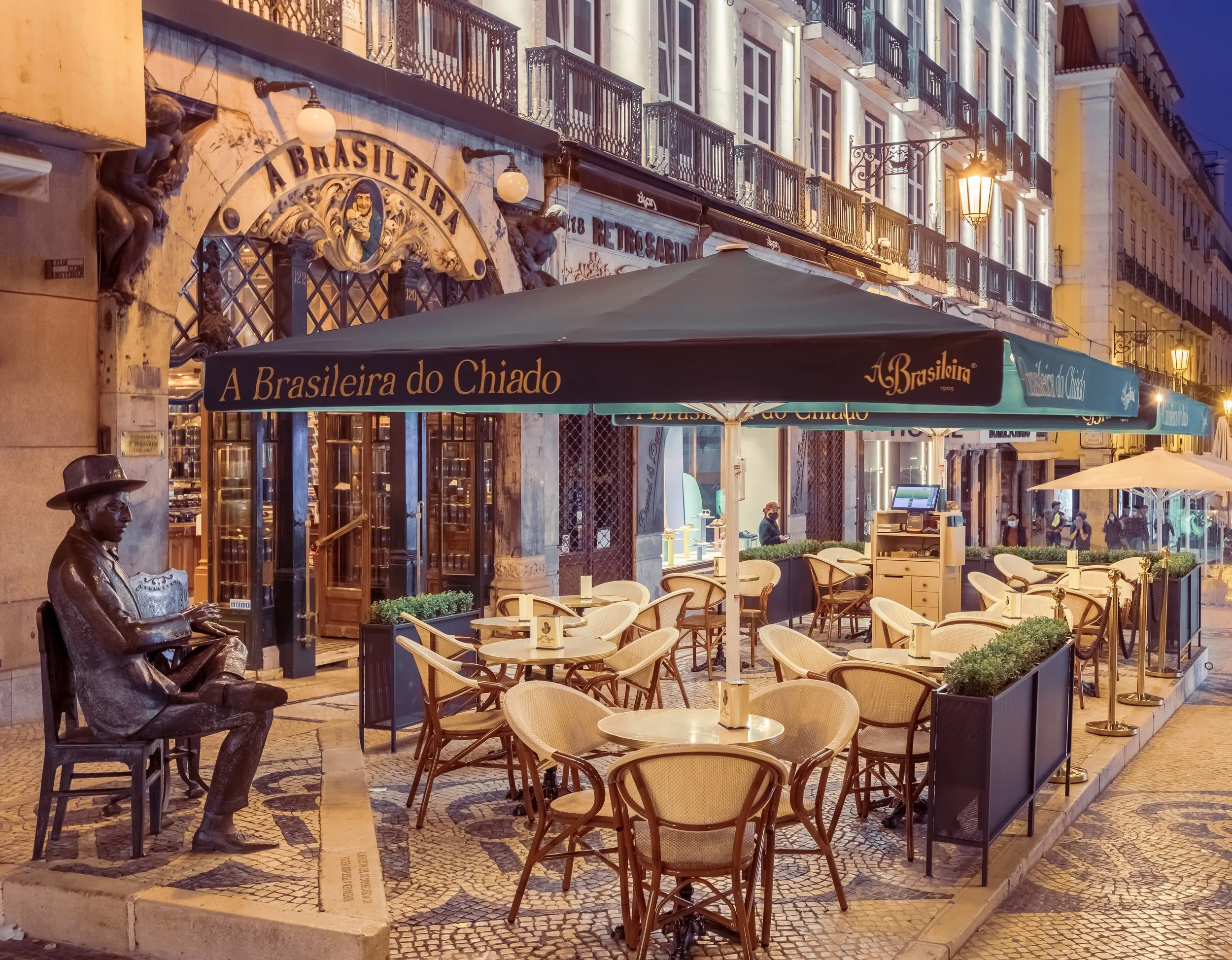
A Brasileira do Chiado founded on November 19 , 1905 at Rua Garrett no. 120-122 in Chiado is one of the three oldest cafes in Lisbon, which have survived the entire 20th century and remain open. Photo by Luisa Paulos.
Coffee arrived in Portugal in the 18th century, largely through its trade routes with Africa and Brazil. Portugal was one of the earlier European nations to develop a coffee culture, and by the 19th century, the café (the coffee house) had become a cornerstone of social life.
Lisbon's historic cafés were gathering places for writers, intellectuals, and politicians. Some of the most famous, like A Brasileira in Chiado, are still standing. They were never just about the drink. They were about having somewhere to be.
That history still shapes how coffee is experienced in Portugal today.
Two very different kinds of café visit
One thing that surprises many visitors is that Portuguese coffee culture isn't one thing; it's at least two, and they feel completely different.
The first is the quick stop. You're on your way somewhere. You step into a café, stand at the counter, order, drink your coffee in a few minutes, and leave. This is common in the morning, around lunchtime, and mid-afternoon. The exchange is efficient but not unfriendly, and nobody rushes you out. There's a shared understanding that some visits are simply about the coffee.
The second is the long stay. You sit down with a friend, a colleague, or your own thoughts. The coffee arrives, and then you're there for an hour. Or two. Nobody comes to move you along, and there’s no sense that your table is needed. This is the neighborhood café as social institution - a place where people catch up, argue gently about football, read the paper, or simply watch the street. These visits can stretch across an entire afternoon.
Both are equally Portuguese and neither is more authentic than the other.
The coffee itself: What's actually in the cup
Portugal is an espresso country, and that’s the starting point for understanding everything else.
When someone in Portugal orders um café, which is the standard, everyday way to ask for coffee, they receive a small, strong espresso. This is what coffee means, by default, almost everywhere in the country. You may hear the word bica used in Lisbon for the same thing, but um café works everywhere and is understood by everyone.
This is quite different from a typical American cup of coffee - the large, filter-brewed drink that sits in a pot and gets refilled. That style of coffee, sometimes called café de filtro or café americano, is not the norm in Portugal. You can find it in some hotels, tourist areas, and larger cities, but you should not expect it as a default.
If you're someone who drinks coffee from a Dunkin' or makes a pot at home in the morning, the shift takes a little adjustment. The cups are small, and the flavors are concentrated. The ritual is quick at the counter, or slow at a table, but either way, you're not getting a 20-ounce cup.
The main coffees you'll see on the menu
Um café— a standard espresso. What most people drink most of the time.
Um café duplo— a double espresso, for when one isn't enough.
Uma meia de leite— literally "half of milk," this is the closest thing to what many Americans think of as a regular coffee. It's served in a larger cup, roughly half espresso and half warm milk. More common at breakfast.
Um galão— espresso with a lot of steamed milk, served in a tall glass. Milkier and lighter than a meia de leite. Also more of a morning drink.
Um garoto— a small coffee with just a little milk added. Somewhere between an espresso and a flat white.
Um café pingado— espresso with just a drop (pingo) of milk. If you like your coffee strong but want to soften the edge slightly, this is the one.
Um abatanado— a longer espresso, closer in volume to an Americano. If you want something closer to what you drink at home but don't want to ask specifically for an Americano, this is a reasonable middle ground.
What about lattes, sweeteners, and milk alternatives?
This is one of the questions we hear most often, so it's worth being direct.
Lattes: Portugal doesn't really have a drink called a latte. The closest equivalents are the galão or meia de leite, depending on what you're after. In Lisbon and Porto, international-style coffee shops, including Starbucks, exist and serve what you'd expect. Outside of those cities, you're working with the traditional menu.
Açúcar (Sugar): Sugar is completely standard, and small packets of white sugar come with almost every coffee. Some cafés also offer açúcar amarelo, raw or brown sugar. If you take your coffee without sugar, just say sem açúcar (without sugar) when you order and nobody will think twice about it.
Adoçante (ArtificialSweeteners): Artificial sweeteners are available in many cafés, though not all. Worth asking if you need it.
Leite ao lado / Creme (Milk on the side / creamer): This isn't really a thing in Portugal the way it is in the US. You won't find half-and-half on the counter, and flavored creamers like hazelnut, vanilla, and so on are essentially absent outside of specialty shops. If you want milk in your coffee, order a drink that already has it built in.
Oat milk, soy milk, and other alternatives: Available in larger cities, particularly in more modern or specialty coffee shops. Outside of Lisbon and Porto, you may struggle to find them. This is one area where expectations may need to adjust, at least for the first few days.
How to place an order
In Portugal, ordering coffee is simple and low-pressure. You don't need to specify size (there is generally one size per drink), and you're not asked for a name for your cup.
At the counter, you can simply say what you want:
Um café, se faz favor.
A coffee, please.
Uma meia de leite, se faz favor.
A half-and-half coffee, please.
Sem açúcar, obrigado/obrigada.
Without sugar, thank you.
If you sit at a table, a server will usually come to you, and the same phrases work. There's no pressure to order immediately, and no rush once you've finished.
One thing to note: tipping in Portuguese cafés is not expected the way it is in the US. Leaving the small change from your order is perfectly normal. A formal tip is neither expected nor required.
A note on the experience
What often catches people off guard isn't the coffee itself; it's the pace.
There's a quality to time in a Portuguese café that's genuinely different. Even a quick stop at the counter has a certain ease to it. And if you sit down, you'll notice that nobody is moving you along. The table is yours for as long as you want it.
For people used to a culture of efficiency (order, receive, leave) this can feel unusual at first.
If you're learning European Portuguese and want to explore more of the language through the culture it's rooted in, Conversa Club is a small, warm community built around exactly that. We'd love to have you join us.
