
How to learn European Portuguese as an adult
Wherever you're starting from - whether that’s first steps, a fresh start, or somewhere in between - this post is for you. Not as a roadmap, but more as a quiet reminder that the path is more manageable than it might look right now.

Maybe you've downloaded the apps. Maybe you finished a streak and then... stalled. Maybe you took a class once and it felt fine, but nothing ever quite stuck.
Or maybe you're just starting out. Maybe you’re drawn to Portugal through travel, family, a relationship, a visa requirement, or something quieter and harder to name. And you're standing at the beginning of something that feels both exciting and a little overwhelming.
Either way, you're in good company. And you're probably further along than you think.
The problem isn't you. It's the approach
Most language-learning tools are built around the ideas of exposure and repetition. The assumption is that if you encounter a word often enough, it’ll stick. And for some things, that's true.
But speaking is different from recognizing. Understanding something when you read it is not the same as finding the words when someone is waiting for your answer.
There's also a practical issue worth naming: European Portuguese (português europeu) has its own distinct sounds, rhythms, and vocabulary. Its vowels are compressed and often reduced. Its pace is quieter, more interior. If the content you've been learning from wasn't designed with that in mind, the confusion you felt wasn't a reflection of your ability. It was a mismatch between what you practiced and what you encountered.
There's also the question of pace and pressure. Learning that's tied to a fixed timeline - to finishing, to achieving, to keeping up - can make any natural pause feel like falling behind. Most adults don't learn languages in straight lines, because life interrupts. Confidence dips when progress isn't always visible. That's not a character flaw; it's just how this works. The best environment for adult learners isn't necessarily the most intensive one. It's the most consistent one.
What actually helps
A few things seem to make a genuine difference for adult learners of European Portuguese, regardless of where they're starting.
Real conversation, not just practice exercises. The moment you hear yourself speaking, even haltingly or imperfectly, something shifts. You stop being someone who is studying a language and start being someone who uses it. Even ten minutes of real conversation does more for your confidence than an hour of vocabulary drills.
One of the most useful things you can learn early on is how to stay in a conversation when you're struggling. In European Portuguese, a few small phrases go a long way:
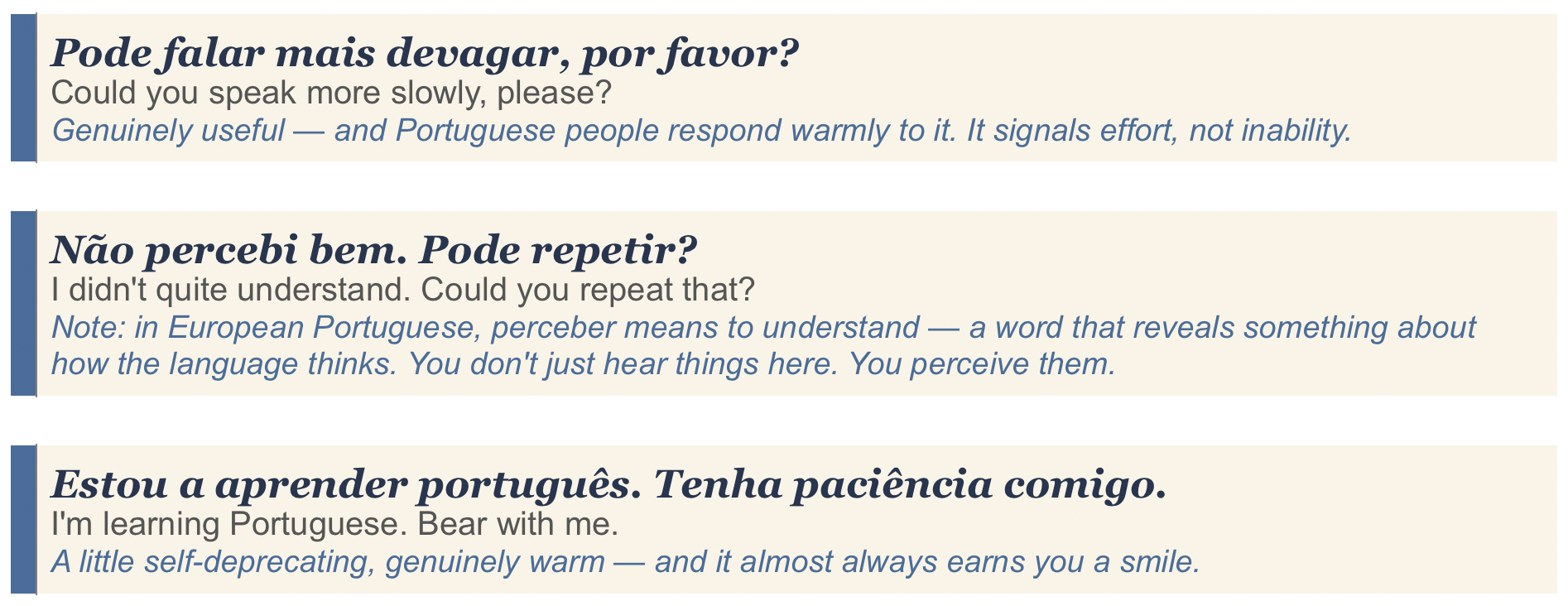
Knowing these phrases means a real conversation doesn't have to end the moment you get lost, because you have tools to keep it going.
Cultural context alongside the language. European Portuguese isn't just a code for communicating; it carries a whole world of reference, feeling, and social habit. The Portuguese tend toward indirectness, understatement, a certain quiet warmth that takes a little time to read. Understanding that register makes the language land differently. It becomes something you want to use, not just something you're trying to learn.
Consistency that fits your actual life. The ideal is not an intense immersion period that exhausts you and then collapses. It's fifteen or twenty minutes of real engagement, regularly, over time. A conversation. A short lesson. A moment of listening and noticing. Small things, repeated. That's what builds something durable.
A place where it's safe to be where you are. Learning a language as an adult involves a specific kind of vulnerability; the experience of not quite being able to express yourself, of knowing more than you can say. Having people around you who understand that feeling changes the whole experience.
If you've tried before and stopped
A lapse is not a failure, and you haven't lost what you learned. Language tends to come back faster the second time, even when it doesn't feel that way at first.

The more useful question is: What made you stop? Was it the pace? The pressure? The feeling that you weren't making visible progress? Those are real reasons. They don't mean you're not suited to this. They usually mean the environment wasn't quite right.
Starting again doesn't have to mean starting from the beginning. It means finding a gentler re-entry point, such as a short conversation, a familiar phrase, a community where no one is keeping score. Something like:

If this is genuinely new territory
The beginning is actually a beautiful place to be, even when it doesn't feel that way. You have no habits to unlearn. Everything you encounter is new and therefore interesting.

European Portuguese has a reputation for being difficult to hear and understand, especially in its natural spoken form. The vowels reduce. The words run together. Native speakers speak to each other, not to language learners. This is all true, and it's also fine. Exposure and time take care of most of it, if you stick around long enough to let them.
One phrase worth learning early, less for practical use and more for what it teaches you about the language:

A word about goals
If you're preparing for the CIPLE exam for a visa or citizenship application, you have a specific destination, and that focus is genuinely useful. There are things you need to be able to do, and practicing toward them makes sense.
But for many adult learners, the goal is something more diffuse and more human than passing a test. It's being able to have a real conversation at a neighbourhood tasca. Following a story a family member is telling. Feeling at home in a place that matters to you. Understanding something on the street and knowing that you got it.
Confidence in real situations is what we're actually working toward. Not perfection. Not fluency by a fixed date. Just the ability to show up in the language and feel at ease in it, passo a passo, step by step.

Where Conversa Club fits in
Conversa Club began as a small community of adult learners gathered around a shared interest in European Portuguese and a shared belief that it didn't have to feel lonely or pressured.
It's still small, deliberately so. What happens in a smaller community is different: conversations are real, not performative. The pace is the community's pace, not an algorithm's.
Sérgio, who founded the community, is very much a part of it. He’s not just the person behind it; he’s there to help you on your learning journey and is available to answer your questions and to have a chat with. He’s spent two decades in education and much of his life navigating between two languages and two cultures. He knows this terrain not just academically but personally. His approach reflects that: calm, unhurried, genuinely invested in the people doing the work.
If you've been looking for somewhere that feels different from what you've tried - more human, more consistent, a place to practice and belong - we'd be glad to have you join us.
Community.ConversaClub.Com
