
O Dia do Trabalhador: The Day Portugal Pauses for the People
Every April 25th, the carnations come out, Grândola, Vila Morena plays at midnight, and the country pauses to remember what was won in 1974. And then, just six days later, May 1st arrives, not as something new, but as the next sentence in the same story.
O Dia do Trabalhador (Workers' Day, or simply May Day) is not a separate holiday so much as a deepening of the one that came before it. If April 25th asks what did we win?, May 1st asks what did we build with it? The two questions belong together.

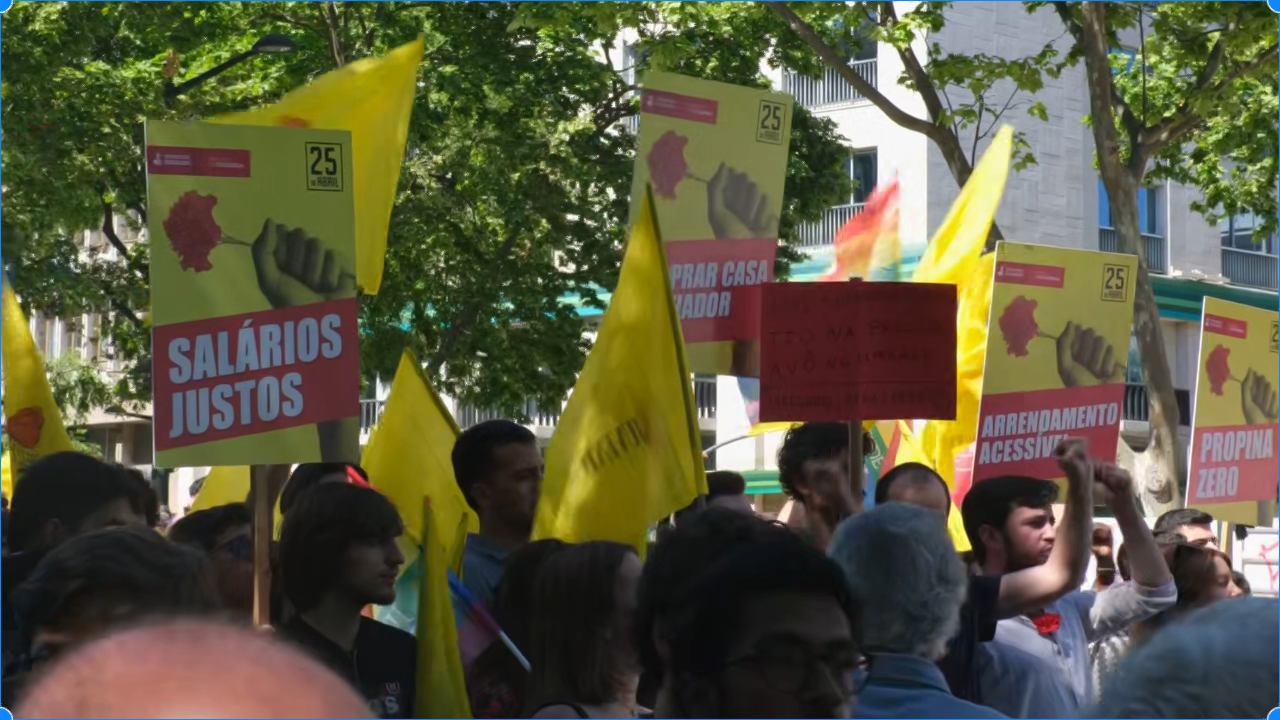
When the Carnation Revolution ended nearly five decades of authoritarian rule in 1974, the right to organize, to speak, to march - to exist as a worker with rights and dignity - was not a given. It had to be built. And May 1st became the day Portugal chose to remember exactly that.
What came before: A country silenced
To understand why o Dia do Trabalhador carries so much weight in Portugal, it helps to understand what workers’ rights looked like under o Estado Novo.
Under Salazar’s regime, independent trade unions were illegal. Workers were organized into state-controlled sindicatos, unions that existed not to advocate for workers but to manage them. The right to strike was effectively nonexistent. Wages were low, and emigration was one of the few ways out. Hundreds of thousands of Portuguese left for France, Germany, and Luxembourg throughout the 1950s and 1960s, sending money home to families who stayed behind.
The colonial wars in Angola, Mozambique, and Guinea-Bissau placed an enormous burden on Portuguese society, draining young men and resources for more than a decade. By 1974, economic, social, and human exhaustion had set in deeply.
When the revolution came on April 25th, 1974, workers’ rights were among the first things people reached for. The very first legal o Dia do Trabalhador in Portugal was celebrated on May 1st, 1974 - just six days after the revolution. It was an enormous, joyful declaration that the silence was over, and that people could gather, speak, and make demands.
What May 1st looks like today
O Dia do Trabalhador is a feriado nacional (national public holiday) in Portugal, and it is observed with genuine feeling, particularly in Lisbon and Porto.
The largest celebrations in Lisbon are traditionally organized by Portugal’s two main trade union federations: the CGTP-IN (Confederação Geral dos Trabalhadores Portugueses) and the UGT (União Geral de Trabalhadores). Both hold marches, rallies, and public events often through the city center and ending near a Avenida da Liberdade or the Almada waterfront.
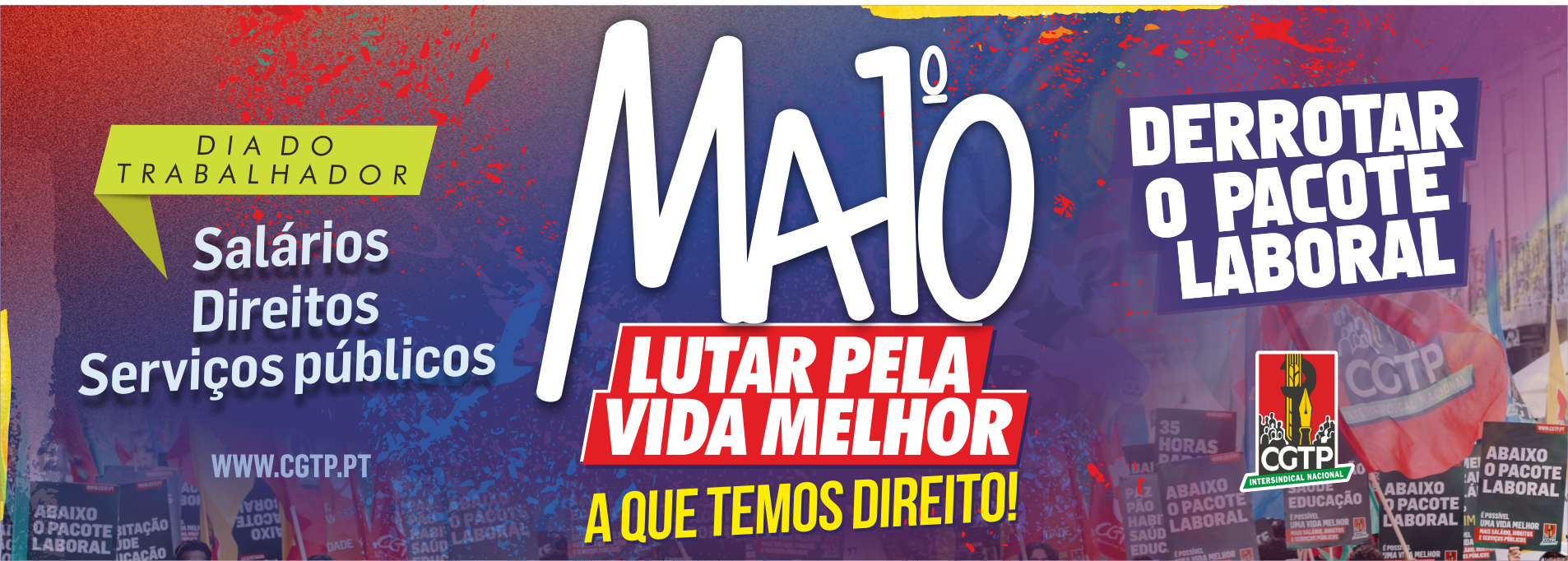
CGTP-IN (Confederação Geral dos Trabalhadores Portugueses) banner for Dia do Trabalhador with the slogan “Lutar pela vita melhor a que temos direito!” (To fight for the better life we are entitled to!)
In Porto, similar marches gather along a Avenida dos Aliados, the same grand avenue that fills with people on April 25th. Northern Portugal has its own strong history of labor organizing, and the city’s celebrations tend to reflect that. They’re grounded, determined, and deeply felt.
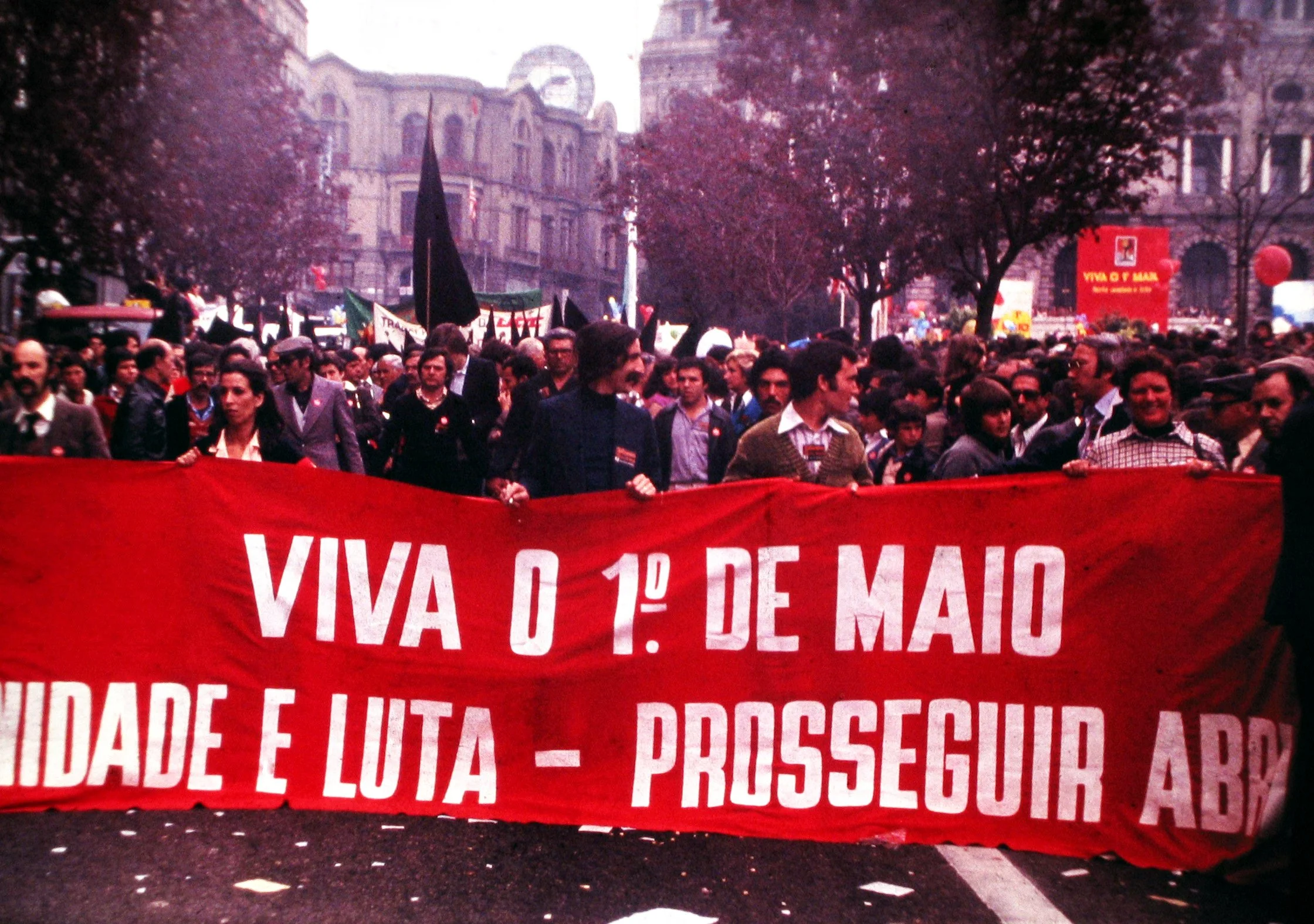
O Dia do Trabalhador Demonstration in Porto, Portugal on May 1, 1980, (By I, Henrique Matos, CC BY 2.5) https://commons.wikimedia.org/w/index.php?curid=6634875
Across smaller cities, towns, and villages, May 1st is marked in quieter ways with concerts, local union events, picnics, and gatherings in public spaces. It is, in the full sense of the word, a people’s holiday.
You’ll also hear music, such as the songs of resistance and solidarity that were banned or impossible to sing publicly under Estado Novo. Zeca Afonso again, because his music runs through both of these spring holidays like a thread. And Sérgio Godinho, and others whose work was woven into the fabric of Portugal’s journey toward democracy.
The word trabalhador and what it carries
Language learners sometimes encounter trabalhador as a vocabulary word and move on. But it is worth pausing here.
Trabalhador (worker) comes from the verb trabalhar (to work), which itself comes from the Latin tripaliare (to torture, to cause suffering). The etymology is uncomfortable but honest. For much of human history, labor was not something freely given. It was extracted.
In European Portuguese, the word trabalhador does not carry that darkness as a lived meaning, but it does carry weight. When Portuguese people speak of os direitos dos trabalhadores (workers’ rights), they are speaking of something that was genuinely fought for within living memory.
This is what happens when you understand the history behind a language: the words stop being abstract. They become specific and real.
Words and phrases worth knowing
If you find yourself in Portugal around May 1st - or simply want to follow conversations, news coverage, and cultural references - here are a few words and phrases worth knowing.
O Dia do Trabalhador - Workers’ Day - The official name for May 1st as a national holiday. Sometimes also called o Primeiro de Maio (the First of May).
Feriado nacional - national public holiday - A useful phrase for any day when shops may be closed, transport schedules may change, and the country collectively pauses.
O trabalhador / a trabalhadora - worker - Note the gendered forms, as in most European Portuguese nouns.
Trabalhar - to work - One of the most common verbs in everyday European Portuguese.
O sindicato - the union - You will hear this word in news coverage around May 1st.
Os direitos - rights
Os direitos dos trabalhadores - workers’ rights
A manifestação - the march, the demonstration - Not to be confused with o manifesto - a written declaration. In everyday speech, you might hear a manif as an informal shortening.
A solidariedade - solidarity - A word with particular resonance on this day.
Viva o Primeiro de Maio - Long live the First of May - A phrase you may hear called out at marches and celebrations, spoken with genuine conviction.
May Day and the rhythm of the Portuguese spring
In Portugal, the end of April and the beginning of May form a kind of emotional sequence.
April 25th arrives first with o Dia da Liberdade and with it, a remembrance of what was reclaimed in 1974: the right to speak, to gather, and to be free. The red carnation appears everywhere. Grândola, Vila Morena plays at midnight, and people stop and listen.
Then May 1st comes, just six days later. And with it, a different but related question: what do we do with freedom? What do we build? What do we protect?
Together, these two holidays form something like a yearly reckoning - a moment when Portugal asks itself who it is and what it values. For a learner of European Portuguese, understanding both is a part of language learning.
Why this matters for your European Portuguese
Here is something no grammar book will tell you: the language you are learning was shaped by silence.
For nearly five decades, certain words were dangerous. Liberdade (freedom). Solidariedade (solidarity). Direitos (rights). These were not neutral vocabulary items. They were charged, contested, and sometimes whispered.
When the revolution came, and then when o Dia do Trabalhador was celebrated openly for the first time in 1974, these words returned to the public. They were sung in streets, shouted at marches, and written on walls.
Understanding this gives you access to something that goes beyond vocabulary: it gives you a sense of why certain words feel heavier in European Portuguese than their English translations might suggest. Why trabalhar is not just a neutral verb. Why solidariedade is not just a concept. Why o Primeiro de Maio is not just a day off.
Real fluency is not just about getting the words right. It is about understanding what they carry.
Resources and further reading
CGTP-IN (Confederação Geral dos Trabalhadores Portugueses) cgtp.pt
UGT (União Geral de Trabalhadores) ugt.pt
Zeca Afonso - explore his discography for the songs that shaped Portugal’s democratic transition.
SONGS:
Celebratory/Restful (Dia de Folga):
"Dia de Folga" - Ana Moura: Fado-pop song celebrating taking a break from the daily grind.
"O Regresso ao Trabalho" - Vasco Palmeirim (feat. Quim Barreiros): Humorous take on returning to work.
Reflective/Social:
"Marcha do Mandrião (Trabalho Vai-te Embora)" - Jorge Ferreira: A lighthearted tune about wishing for a break from work.
"Canções de Trabalho" (Work Songs) - Luís Tinoco: Compositions based on traditional Portuguese work songs.
"Canta, Canta Portugal" - Tony Carreira: Frequently played at popular celebrations, including Labor Day events.
"Se Dançar É Só Depois" - Ana Lua Caiano: A recent song discussing the excess of work:
