
European Portuguese: A cultural portrait of the language
Every language holds a world inside it. Here’s what lives inside European Portuguese, and why it matters for the way you learn it.

Cabo da Roca (Cape Roca) in Portugal is the westernmost point of continental Europe. Located at 38°46'N 9°30'W within the Sintra-Cascais Natural Park, it features a 140-meter-high cliff, a lighthouse, and a monument.
We’ve written before about how European Portuguese sounds - the vowel reduction, the compressed rhythms, the particular texture of its consonants. But there’s also a different kind of question worth considering: not how the language sounds, but what it carries. What it holds inside it. The history, the values, the ways of being in the world that Portuguese people have been encoding in their language for centuries.
You can learn every grammar rule, memorize every irregular verb, and still feel like a stranger in the language. And you can have a relatively modest vocabulary and feel completely at home in it. The difference, more often than not, is cultural fluency - a sense of what the language means, not just what it says.
A small country that navigated a very large world
To understand European Portuguese, it helps to understand something about Portugal itself and about the particular emotional position it occupies in history.
Portugal is a small country on the western edge of Europe, facing the Atlantic. In the fifteenth and sixteenth centuries, it sent ships to places no European had charted, establishing trade routes and settlements across Africa, Asia, and the Americas.
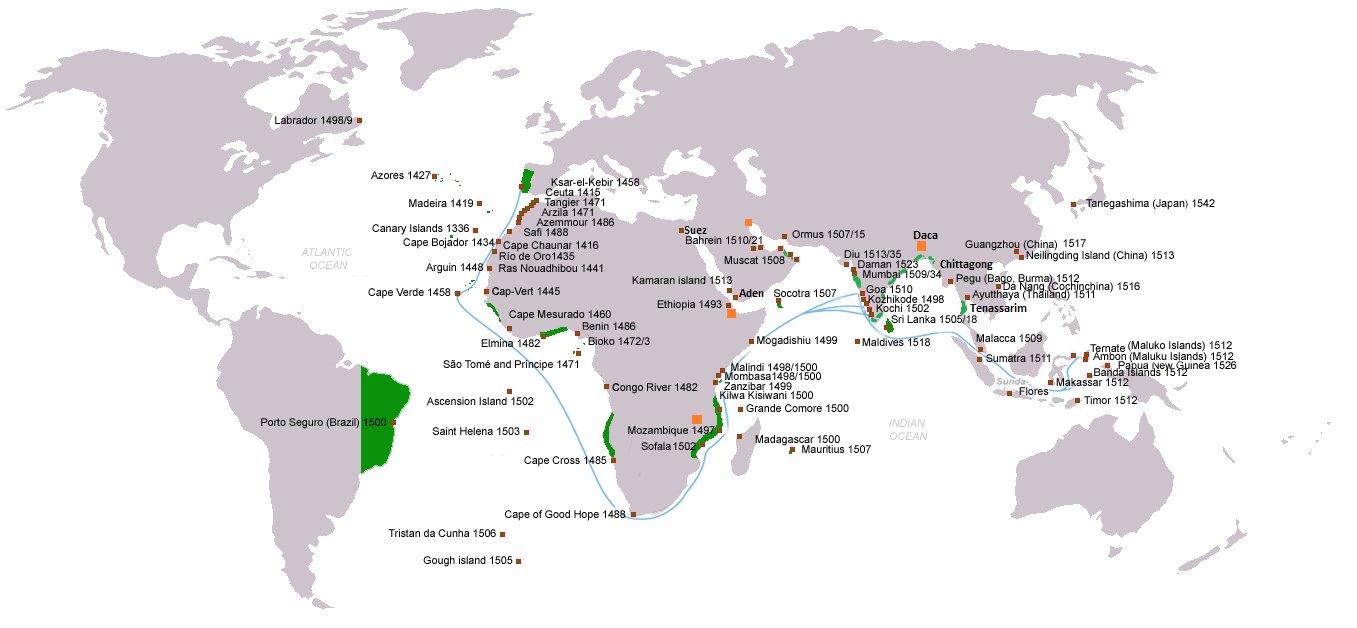
Portuguese exploration and discoveries: first arrival places and dates; main Portuguese spice trade routes in the Indian Ocean (blue); territories claimed during the reign of King John III (c. 1536) (green); Main Factories (orange)
For a time, Portugal was one of the most powerful empires in the world. And then, gradually, it wasn’t. Other empires rose and Portugal contracted. The twentieth century brought dictatorship, isolation, and a long, costly colonial war that ended only in 1974 with the Carnation Revolution, a peaceful uprising that restored democracy after nearly fifty years of authoritarian rule.
What does any of this have to do with the language? Everything. A country that has known both vast reach and profound loss, both outward expansion and long inward withdrawal, develops an emotional register unlike any other. And that register lives in the language, in its particular combination of warmth and restraint, openness and guardedness, melancholy and resilience.
Once you know what to listen for, you really can hear it.
The words that carry the most weight
Every language has words that are genuinely untranslatable, not because translation is impossible, but because no single word in another language carries the same weight, the same associations, the same emotional charge. European Portuguese has several of these. They’re worth knowing not as curiosities, but as keys.
Saudade
Saudade is probably the most-discussed word in the Portuguese language, and with good reason. It describes a longing for something loved and absent - a person, a place, a time, a feeling - that is neither quite grief nor quite nostalgia, but something that contains both and transcends them.
What makes saudade culturally significant isn’t just the feeling it names. It’s the fact that Portuguese has a word for it at all; that the culture found this particular emotional state important enough to give it its own term, its own gravity. Saudade is not considered a sad word in Portugal. It is considered a deep one. To feel saudade is to have loved something enough to miss it fully.
The poet Fernando Pessoa, Lisbon’s great literary figure, wrote that saudade is the love that remains after something is gone. Pessoa’s verses and phrases portray saudade not just as missing someone, but as a constant state of mind and a form of poetry that fills the silence of absence.
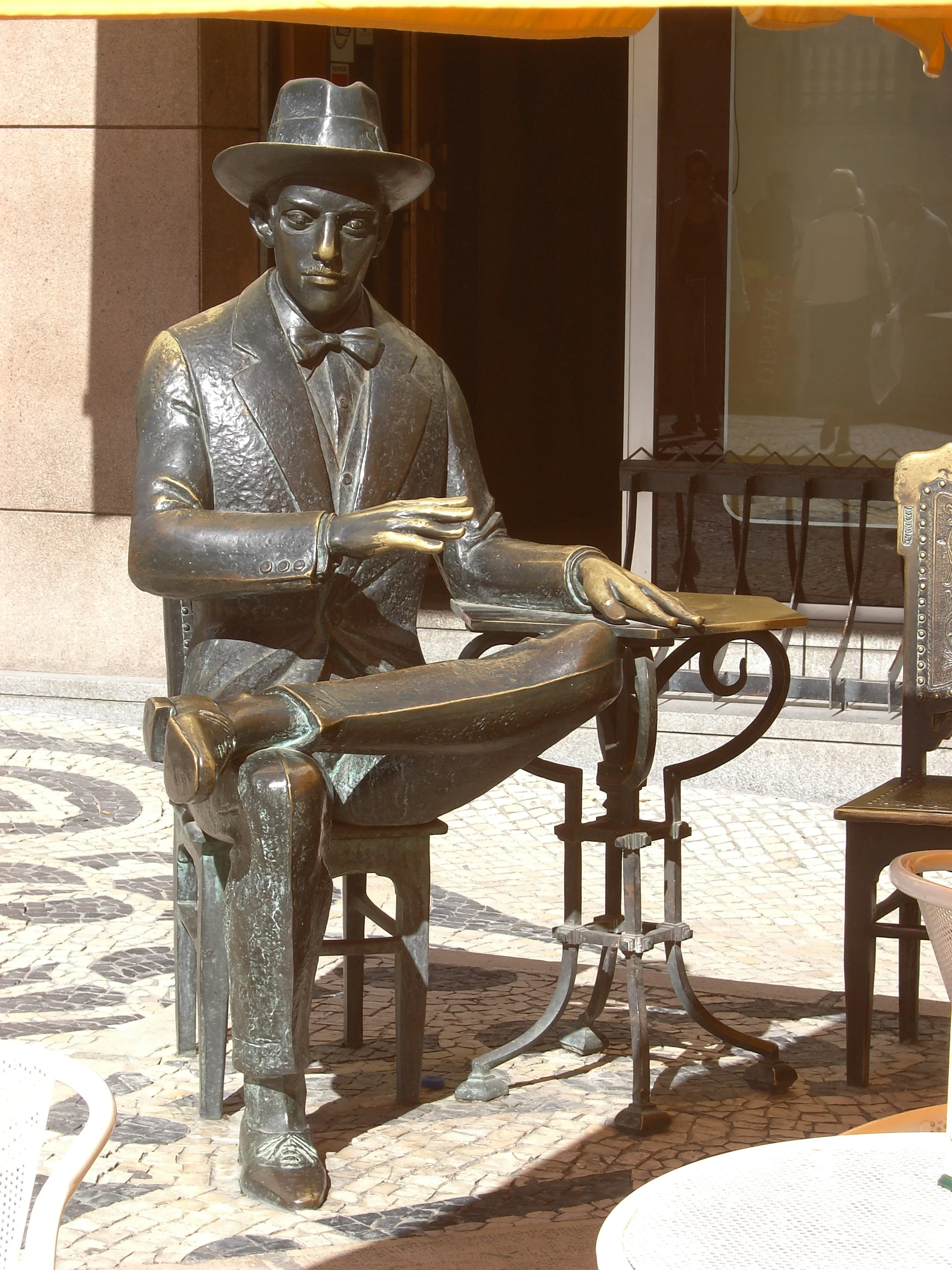
Fernando Pessoa's statue outside Lisbon's famous coffeehouse "A Brasileira"
"Saudades! Tenho-as até do que me não foi nada, por uma angústia de fuga do tempo e uma doença do mistério da vida"
(Saudades! I even miss what was nothing to me, due to an anguish of escaping time and an illness of the mystery of life")
"Ah, não há saudades mais dolorosas do que as das coisas que nunca foram!"
("Ah, there are no more painful longings (saudades) than for things that never were!")
"Sinto mais longe o passado, / Sinto a saudade mais perto"
(“I feel the past further away / I feel the longing (saudade) closer.”)
This tells you a great deal about the Portuguese relationship to absence, to time, and to attachment.
Sossego
Sossego is quieter than saudade, and in some ways more revealing. It means, roughly, a state of inner peace; but not the absence of noise. A deeper kind of ease. A settled calm. It is used to evoke a sense of relaxation, contentment, and a slow-paced lifestyle. The Portuguese use it to describe both a particular moment (the sossego of a Sunday afternoon, the shutters half-closed against the heat) and a quality they actively seek in life.
In a culture that is often described from the outside as melancholic, sossego is the counterweight; the reminder that the Portuguese relationship to stillness is not passive or resigned, but chosen, cultivated, valued.
If you spend time in Portugal, you’ll feel sossego before you know the word for it. And once you have the word, something clicks into place.
Só quero paz e sossego.
(All I want is peace and quiet.)
Este é um bairro pequeno e pacato, ideal para quem procura sossego.
(This is a small, quiet neighborhood, ideal for those looking for peace.)
Aprecio quando as pessoas respeitam o meu momento de sossego.
(I appreciate it when people respect my quiet time.)
Às vezes, é bom escapar para o sossego das regiões mais afastadas.
(Sometimes, it's nice to escape to the quiet of more remote areas.)
Desenrascаnço
Desenrascanço describes the ability to improvise your way out of a difficult situation using whatever is available. To find a creative, improvised solution when the obvious one isn’t working. To get yourself unstuck through ingenuity rather than resources. To turn constraints into creative opportunities.
It’s a word that captures something genuinely admired in Portuguese culture: pragmatic resilience. The capacity to adapt, to make do, to find a way. A small country that once navigated the world with limited means had to develop this quality, and the language preserved it.
There’s a warmth to desenrascanço that pure equivalents like “improvisation” or “resourcefulness” don’t capture. In English, improvising in a crisis might be neutral or even slightly embarrassing. In Portuguese, it’s something closer to a virtue.
Vou desenrascar um jantar com o que tenho no frigorífico. (I'm going to make dinner with what I have in the fridge.)
Ele desenrascou-se bem na entrevista. (He handled himself well in the interview.)
Não te preocupes, eu desenrasco-me. (Don't worry, I'll manage.)
Fado the sound of feeling
Fado is the traditional music of Lisbon, and probably the most direct window into the emotional world of European Portuguese. The word means “fate.” The music sounds like it - beautiful, inevitable, intimate, a little heartbroken.
Fado emerged in the working-class neighborhoods of Lisbon in the nineteenth century; in Alfama, the old Moorish quarter that climbs the hill below the castle, and in Mouraria, the neighborhood at its foot. It was the music of people who had little, who had suffered loss, who kept going anyway. Over time it developed into something more formal, more celebrated, eventually recognized by UNESCO as an Intangible Cultural Heritage of Humanity. But its emotional core, that particular mixture of grief and beauty, of longing and acceptance, has never really changed.
The great fadista of the twentieth century was Amália Rodrigues, whose voice carried saudade so completely that she became almost synonymous with it.
For learners, fado is valuable beyond its cultural richness. Because it moves slowly and with emotional intention, it’s one of the most accessible forms of natural European Portuguese to listen to. The vowel reduction is present but unhurried. The phrasing is deliberate. You begin to hear the shape of the language - its particular weight, the way it breathes - without needing to catch every word.
Listen to Amália’s Estranha Forma de Vida, or Mariza’s Casa. You don’t need to understand the lyrics to feel what the language is doing.
Everyday culture: What ordinary life sounds like
But culture isn’t only art and history. It’s also the texture of ordinary days - the objects, the rituals, the rhythms that structure life in a particular place. European Portuguese is full of words for these things, and knowing them changes how the language feels.
“Um café” and “a pastelaria”

In Portugal, you can order coffee by asking for um café - a short, strong espresso served in a small ceramic cup, almost always with a little packet of sugar resting on the saucer. You'll hear um café from Lisbon to Braga to the Algarve. It's one of those phrases that feels almost too simple, until you realise how much it carries. Not just a coffee order, but a whole set of assumptions about how a morning begins, how a conversation pauses, how a working day is punctuated.
A pastelaria is where you go for it; not quite a café, not quite a bakery, but something of both. Marble counters, glass cases of pastries, the smell of custard and coffee. A pastelaria in Portugal is a social institution as much as a business. People go not just to eat but to stand, to talk, to mark the beginning or end of something.
None of this is vocabulary for vocabulary's sake. Um café and uma pastelaria tell you something about how the Portuguese relate to time; that moments of pleasure are brief but taken seriously; that public life has its own rituals; that there is comfort in small, repeated things.
“Pois” and the sound of quiet agreement
Some of the most culturally loaded words in any language are the ones that seem, on the surface, to mean almost nothing. In European Portuguese, pois is one of these.
Technically, pois means “yes” or “indeed” or “exactly.” In practice, it does something more subtle. Said with a slight downward inflection, it signals calm acknowledgment, not enthusiastic agreement, but a kind of settled, thoughtful assent. It says: I hear you. I am with you. We understand each other.
You’ll hear pois constantly in conversation. And when you start using it correctly, with the right weight and timing, something shifts. You stop sounding like someone reciting Portuguese and start sounding like someone who lives in it.
Why this matters for learners
There’s a tendency in language learning to treat culture as a bonus, as something you add once you’ve mastered the grammar, a reward for getting the hard parts right. But that gets it backwards.
Culture is not the decoration on top of a language. It’s the structure underneath it; the reason words mean what they mean; the reason certain ideas have names and others don’t; the reason some phrases land with weight and others fall flat. All of that is cultural. All of it is learned through immersion in the world the language comes from, not through conjugation tables.
This is why, at Conversa Club, we talk about learning European Portuguese as learning a whole world, not just a communication system. The saudade, the fado, the sossego, the pois: these aren’t peripheral. They’re the point.
And the good news is that this part of learning - the cultural part, the human part - is also the most enjoyable! It doesn’t feel like study. It feels like getting to know somewhere, and someone, you’ve been curious about for a long time.
