
Tudo bem? The greeting loop you'll use every single day
There are two phrases that open almost every conversation in Portugal. Most people use them so naturally that they don't even notice they're doing it. Together, they form a loop - a small, familiar exchange that signals warmth and ease before a single real word is spoken.
This lesson is about that loop.
The first phrase: Tudo bem?
Tudo bem? translates literally as "everything good?". But in practice, it works exactly like "how are you?" It's the opener. The greeting before the greeting.
You'll hear it everywhere: At the pastelaria counter, from a neighbor on the stairs, from a colleague as they pass your desk. It's light, it's common, and it's the right place to start.
The reply: Tudo bom.
Here's where the loop begins, because tudo bem? almost always gets the same answer.
Tudo bom.
The two phrases look similar, and they are. The difference is grammatical: bem is an adverb (things are going well), and bom is an adjective (things are good). In practice, most speakers use them interchangeably, and you'll hear both.
Completing the loop: E tu? / E você?
After tudo bom, there's one more move. You bounce the question back.
E tu? And you? (informal)
E você? And you? (polite)
Tu is for people you know, such as friends, family, people your age, and people you're comfortable with. Você is for strangers, elders, and formal situations: a shop, a bank, a new workplace.
Both are correct. The choice simply signals your relationship to the person.
The full loop, in context
Here's how it sounds between two neighbors crossing paths on the street:
Tudo bem?
Tudo bom, obrigado. E tu?
Tudo bem.
That's it. That's the loop.
Notice that tudo bem does double duty. It opens the exchange and closes it. It's both the question and the answer.
Two more phrases worth knowing
Mais ou menos (more or less) is the honest answer when things are fine, but not exactly wonderful. Very human, very common.
Não me posso queixar. (I can't complain.) is a warm and slightly wry response. You'll hear this especially from older speakers.
Both fit naturally into the loop:
Tudo bem?
Mais ou menos. E você?
Não me posso queixar.
The six phrases, all together
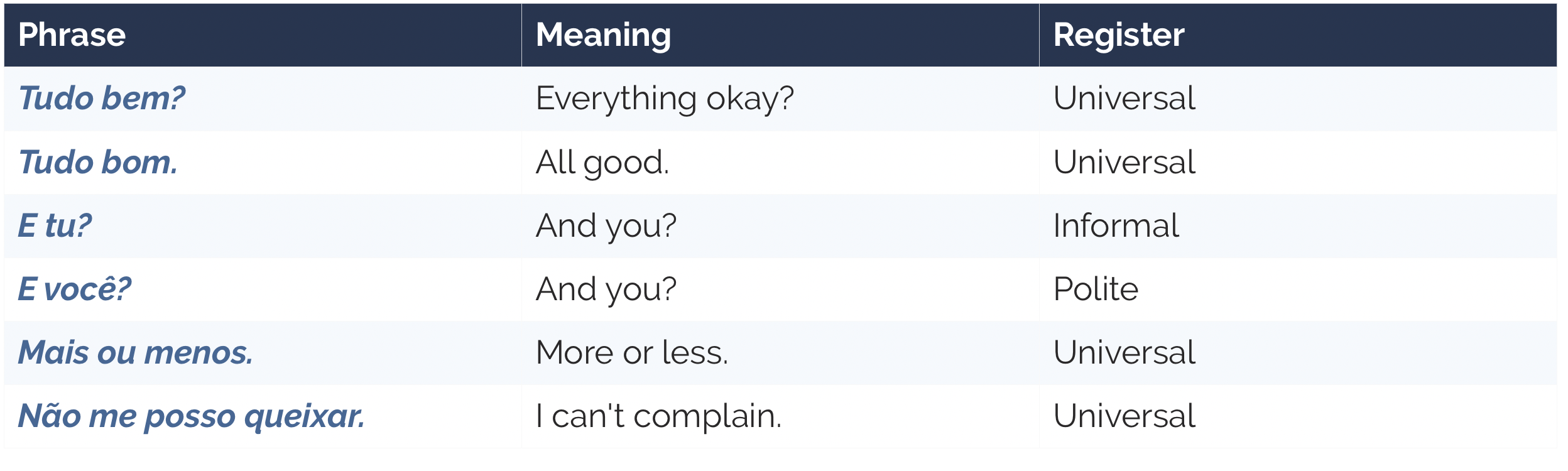
These six phrases won't take you through a whole conversation. But they'll open one calmly, naturally, and in real European Portuguese.
Uma pequena lição de cada vez.
Want to keep going?
Conversa Club is a community for adult learners of European Portuguese. It’s built around real conversation, cultural connection, and steady, human progress. Join us at Community.ConversaClub.com.
