
Fado and the Language You Feel Before You Speak It

There is a particular kind of silence that happens when a fadista finishes singing. Not the silence of an ending, but the silence of something still settling. The notes are gone, but the feeling lingers, the way light stays in a room after the sun has moved.
If you have ever heard fado and found yourself moved without quite knowing why, you already understand something essential about European Portuguese. Something that no grammar book will ever teach you.
The language arrives before the words do
One of the quiet truths of language learning, and one that rarely gets said out loud, is that understanding isn't always what happens first. Feeling is.
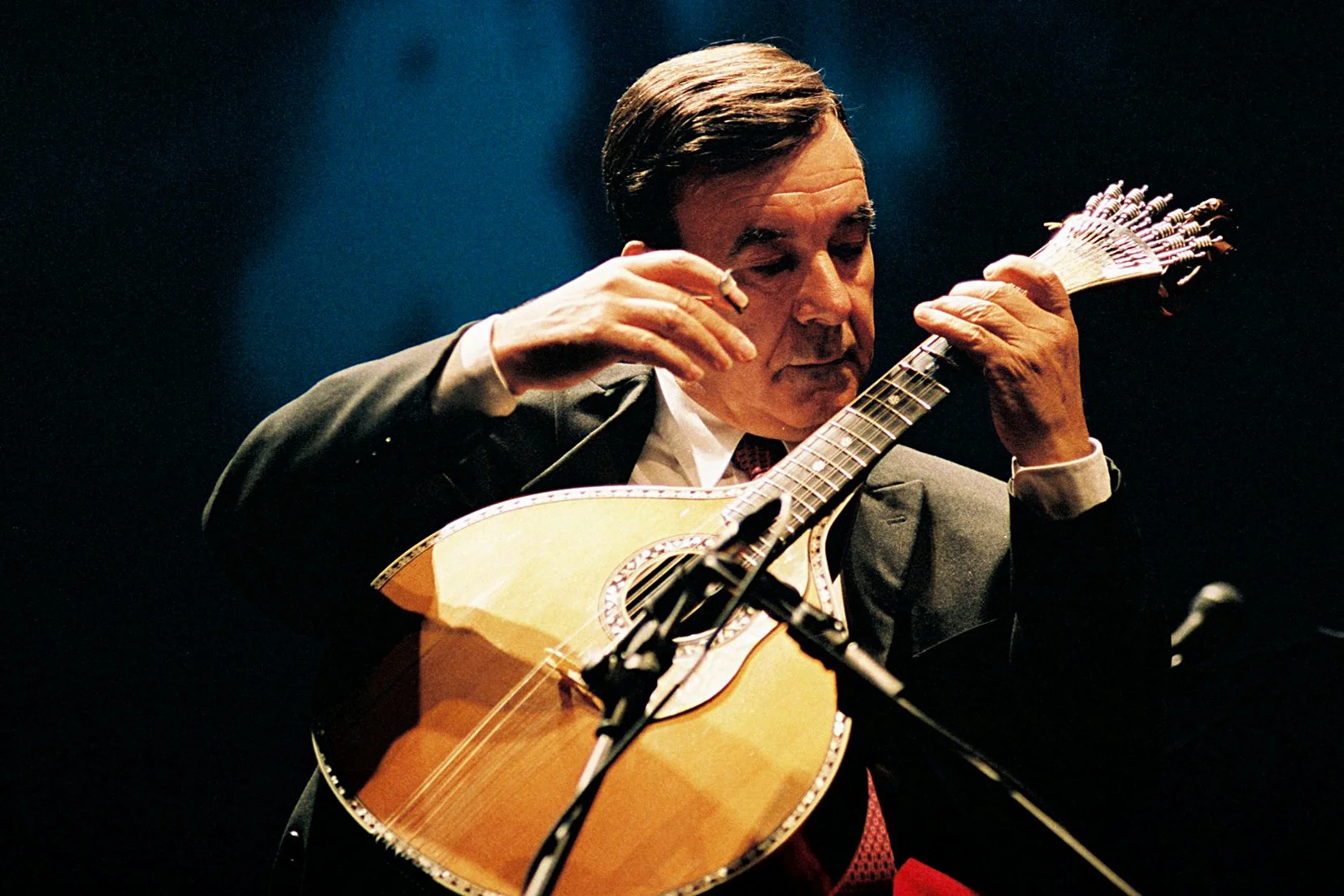
António Chaínho. (1938 - 2026) Internationally recognized Portuguese guitarist and composer. Considered an ambassador of the guitarra portuguesa.
Long before you can follow a conversation, you can feel the weight of it. You can sense when something is tender, when it’s formal, when it’s tinged with loss. The rhythm of European Portuguese has a texture to it, and fado makes this quality audible.
Listen to guitarra portuguesa (the Portuguese guitar) and you will hear it immediately. That particular timbre, those notes that seem to turn back on themselves. It’s structural, not decorative. It’s built into how the music moves; the same way certain sounds are built into how the language moves.
The instrument itself has a remarkable history. It descends from earlier European cittern traditions, later adapted in Portugal with two distinct regional tunings; one for Lisbon and one for Coimbra. Its bright, metallic sound and intricate ornamentation became inseparable from fado over the course of the nineteenth century. When you hear it, you are hearing centuries of Portuguese musical memory in a single phrase.
Where fado came from
Fado emerged in Lisbon in the first half of the nineteenth century, in the working-class neighborhoods of Mouraria, Alfama, Bairro Alto, and Madragoa. It wasn’t born in concert halls or aristocratic salons. It was born in taverns, outdoor gatherings, and the informal spaces of Lisbon's street life.
It was music of the people - fishermen, sailors, dockworkers, and women living on the margins of society. It expressed loneliness, separation, and the emotional weight of voyages at sea. Lisbon in that era was a city at a crossroads, teeming with internal migrants from rural Portugal, returning sailors, and influences from the Portuguese empire. The music reflected all of that.
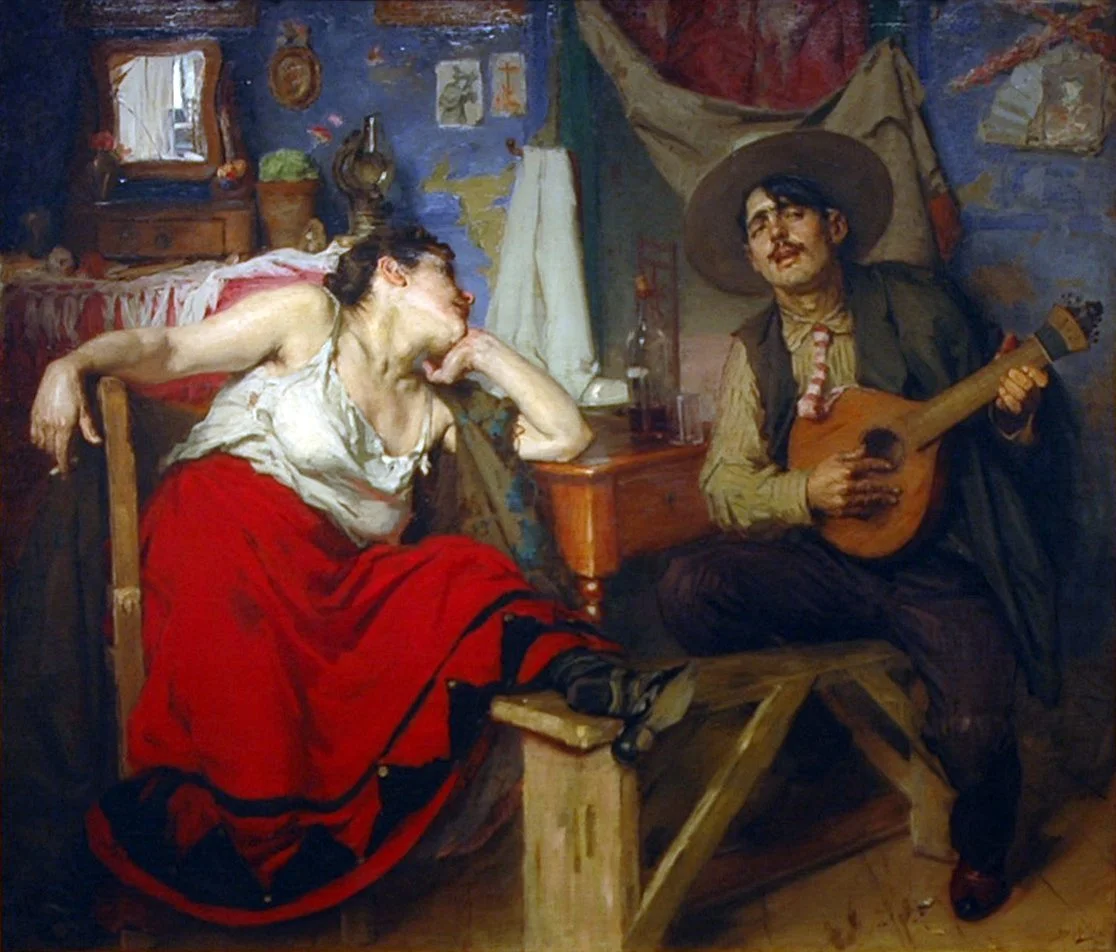
O Fado. 1910. José Malhoa
Historians trace fado's roots to a multicultural mix: African rhythms, Afro-Brazilian sung dance traditions that arrived in Lisbon when the Portuguese royal family returned from Brazil in the 1820s, the soft romantic modinhas of Portuguese salon culture in Brazil, maritime songs carried home by sailors, and the rural music of internal migrants arriving in the capital. Lisbon's multicultural character is what made fado possible.
One of the earliest figures associated with the tradition was Maria Severa Onofriana, known simply as Severa, a young woman from Mouraria whose short life became part of fado mythology. Her story, part history and part legend, anchored the genre to specific streets and specific social worlds, and helped establish the image of fado as a vehicle for tales of love and misfortune.
The aesthetic that emerged alongside the music is still recognizable today. Female performers in simple, dark clothing, including a black shawl draped around the shoulders. Male performers in suits, standing with a composed gravity. Dignity and drama is built into how they dress to sing.
What fado teaches that a lesson can't
Fado is not a genre that explains itself. It doesn't announce its themes or summarize its feelings. It simply presents them and trusts you to receive them.
This is, in many ways, how European Portuguese works in real life.
Context and tone carry enormous weight. A single word, for example pronto or então, can mean completely different things depending on how it lands, how long it sits in the air, and what came before it. You learn this not by memorizing definitions, but by listening and being present. By letting the language move through you before you try to hold it.
Saudade is real, but it isn’t the whole story
You have probably encountered saudade already. It’s the word most often reached for when people try to describe fado, the feeling most often called “uniquely Portuguese”.
It’s a genuine word for a genuine emotional state; a longing for something loved and lost, or perhaps never fully had; a tenderness toward the absent; a longing; nostalgia; homesickness; or the ache of memory. It’s one of those words that European Portuguese carries in a way that resists translation.
But fado is not only saudade. It is also alegria, joy. It is irreverence, humor, and protest. There are different types: fado menor is slow and melancholic, sung in a minor key; mouraria is nostalgic but in a major key and faster; corrido has cheerful, upbeat music even when the words do not match that mood. The tradition has produced songs about injustice, about ordinary working life, and about the very neighborhoods that gave it birth.
And then there is the history. Because fado was associated with the Salazar dictatorship - Salazar himself promoted fado, Fátima, and futebol as the three pillars of national identity - many Portuguese people came to have an ambivalent relationship with the genre after the 1974 revolution. It took decades, and a new generation of artists, to reclaim fado as something greater than its political history.
Listening as a form of practice
There is a tradition at fado performances called silêncio, silence. Before the music begins, someone in the room will call for it, and the entire audience stills. It is not just courtesy. It’s a way of preparing to receive something.
We could borrow that spirit for language learning.
So much of what we call studying is actually rushing past what we don't understand and toward the next vocabulary item, the next rule, the next level. But real listening requires the opposite: slowing down, staying present, letting meaning accumulate gradually rather than demanding it all at once.
If you are learning European Portuguese, or finding your way back to it, fado is a genuine resource. Not because it will teach you vocabulary, but because it will tune your ear. It will acquaint you with the sounds that European Portuguese makes when it is most itself: the vowel reductions, the consonant clusters, the particular music of a language shaped by centuries of the sea, the Reconquista, the descobrimentos (the discoveries), and everything that followed.
You do not have to understand every word to benefit. That is rather the point.
Where you might begin
If fado is new to you, a few names worth knowing are:
Amália Rodrigues (1920–1999), considered the definitive voice of traditional fado, the Rainha do Fado, the Queen of Fado. Her career spanned more than fifty years, and her recordings remain the standard against which every subsequent artist is measured. She is essential and irreplaceable.
Mariza brought fado to a new international generation while remaining deeply rooted in its Mouraria origins. Her voice is unmistakable. It’s powerful, precise, and full of feeling.
Ana Moura has explored where fado meets contemporary music, expanding the tradition without losing its soul.
Carminho is widely loved for the warmth and accessibility of her voice. Her music is a good entry point if fado feels daunting at first.
Listen without trying to translate. Then, when you’re ready, come back to the words. You may find that something has already shifted and that the language feels a little less foreign and a little more familiar.
That’s not a small thing. It’s the beginning.
Explore more about European Portuguese culture and language in the Conversa Club community. If any of this resonates — if you felt something reading it before you could explain it — you are exactly where you need to be.
