
The letter O in European Portuguese: Four sounds worth knowing
If you've ever heard a European Portuguese speaker say domingo and thought, that didn't sound like an O at all, you're not imagining things.
The letter O in European Portuguese is one of those sounds that quietly surprises learners. It shifts depending on where it sits in a word and whether it carries an accent. The good news: once you understand the four main patterns, everything starts to click.
This post walks through each one, step by step.
The open stressed O
This is probably the most familiar O sound for English speakers. It’s an open, rounded sound a little like the vowel in ball or more.
In European Portuguese, you'll hear this sound when the O falls in the penultimate (second-to-last) syllable of a word, without needing any written accent to signal it. The placement itself does the work.
A few examples:
bola — ball
porta — door
livro — book (the O in the first syllable)
Say bola out loud. That open, unhurried O in the first syllable, that's the one to listen for. It's not stressed or forced. It's just open.
The closed, stressed, circumflex Ô
When you see the circumflex accent over an O (ô), the sound becomes more closed, rounder, tighter, held slightly more at the back of the mouth.
Think of the difference between the open sound in ball and a more contained, pursed sound. It's a subtle shift, but native speakers hear it clearly.
Examples:
avô — grandfather
pôr — to put, to place (also used in the expression pôr do sol, sunset)
Avô is a word many heritage speakers know from childhood, and now you can hear exactly what that Ô is doing.
The unstressed O: When it sounds like a U
This is the one that tends to catch people off guard the most.
In European Portuguese, when the O is unstressed — particularly in the first syllable of longer words — it shifts toward a sound closer to oo (like the English 'oo' in boot). It's not quite a U, but it moves noticeably in that direction.
The classic example is domingo (Sunday).
Say it the way you might expect: do-mingo. Now say it the way a European Portuguese speaker would: closer to du-mingo. Both O sounds in that word, the first and the one in the third syllable, move toward that oo quality.
This unstressed shift is one of the reasons European Portuguese can feel so different to the ear at first. Words that look familiar on the page sound rounder, more compressed, when spoken naturally.
Nasal O sounds
Like its cousin the nasal I (which gets its own lesson), the nasal O appears when the letter is followed by m or n or written with the tilde (õ). The air moves up through the nasal passage, giving the sound a warm, resonant quality that's very characteristic of European Portuguese.
A few examples:
bom — good (masculine)
som — sound, tone
bons — the plural of bom, where the nasal quality stays
sons — the plural of som
The nasal O is one of those sounds that's hard to describe in writing but immediately recognizable in speech. The more you listen, the more natural it becomes.
The acute accent O: Ó
The acute accent on the letter O (ó) signals two things at once: the stressed syllable, and an open vowel sound (/ɔ/). Open your mouth a little wider than usual, similar to the ‘o’ in the English words cord or fork, and that openness is the key.
A few things worth knowing about ó:
Open pronunciation (/ɔ/). The mouth opens wider than for a regular O. You’ll hear it in avó (grandmother), pó (dust), and óculos (glasses).
Stressed syllable. The accent mark is also a stress marker; the syllable carrying ó is always the one you emphasise.
A minimal pair worth knowing. This is where ó and ô do real work. Avó [ɐˈvɔ] means grandmother (open vowel); avô [ɐˈvo] means grandfather (closed vowel). One letter, one accent, two entirely different people.
Common usage. You’ll encounter ó frequently in everyday words where the stress falls outside the usual pattern, such as automóvel (car) and ótimo (great, excellent).
Putting ó alongside the circumflex ô from the earlier section, the contrast becomes clear: the acute opens the sound up, the circumflex closes it down. Both carry stress, but they lead you to completely different mouth shapes, and in real speech, different meanings.
Putting it all together
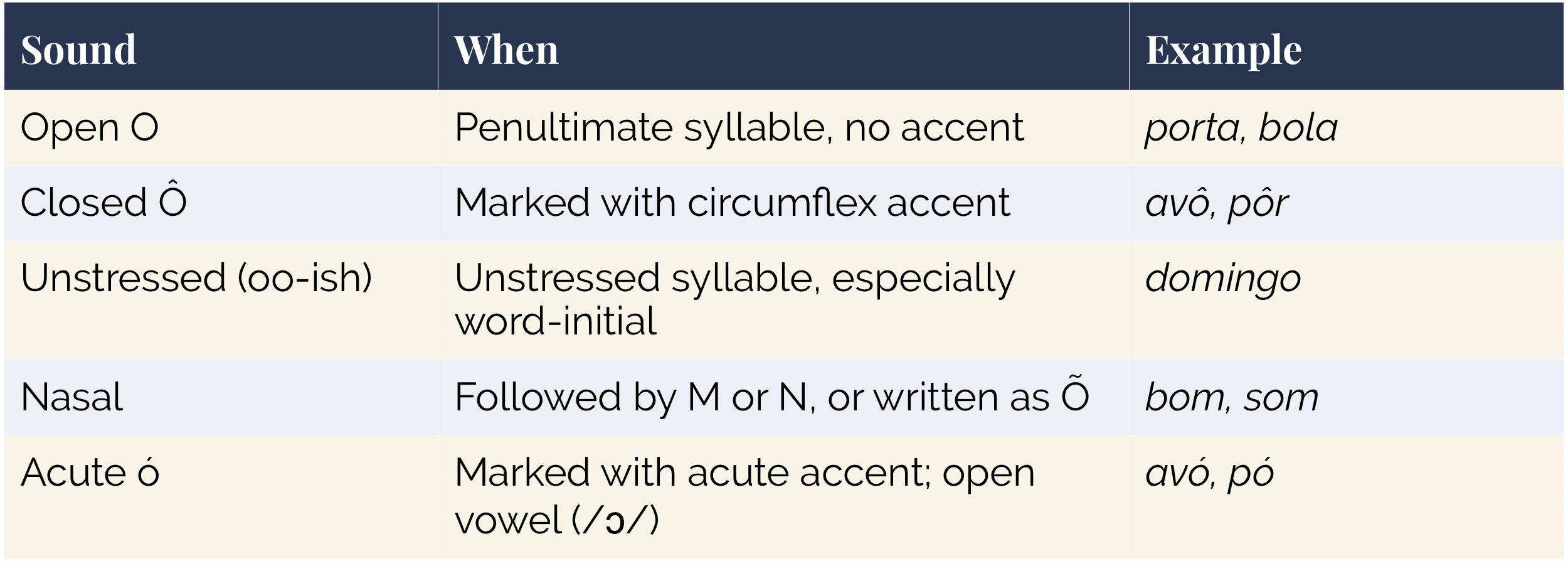
Don't worry about getting every one of these exactly right from the start. These sounds take time; they're absorbed through listening, through practice, through the gradual process of tuning your ear to how European Portuguese actually moves.
Watch the full lesson
And if you'd like to keep exploring European Portuguese step by step, come join us at community.conversaclub.com. Whether you're just starting out or finding your way back after a pause, there's a place here for you.
